
Your TechnologyPartner, Not Just Another Vendor
25+ years of web development experience — banks, insurance companies, retailers, tech firms. Scalable, secure, and open for further development.
25+ years of web development experience — banks, insurance companies, retailers, tech firms. Scalable, secure, and open for further development.






We implement comprehensive solutions across the entire technology stack. Our development teams are proficient in:
Cloud Infrastructure: AWS, Azure, Google Cloud Platform
Our integration specialists ensure your new systems work harmoniously with existing enterprise architecture, including:
Reduce time to market with our AI-driven development:
By combining various approaches, such as Lean or waterfall, we create a tailored development process that aligns with each project's specific requirements, based on:
Every engineer at Creatim uses AI daily — and every line it touches is reviewed by a senior engineer before it reaches your codebase.
Scaffolding, boilerplate, test generation, first-pass code review, and documentation drafts move at AI speed — freeing senior engineers to spend their time on the decisions that actually require judgment.
Architecture decisions, integration logic, compliance-relevant code (data handling, access control, audit trails), and anything touching safety or contract-pricing logic are designed and signed off by a senior engineer — never AI-authored end to end.
Every AI-assisted contribution is reviewed and approved by a named senior engineer before merge. There’s always a person on your project who can explain — and stand behind — why a line of code exists.
Our AI governance model runs alongside the same ISO 27001, DORA, and NIS2 obligations we already build to. It’s part of how we deliver, not a policy bolted on afterward.
Based on your business processes and project requirements, we will analyze the project to define:
We implement multi-layered quality assurance processes to ensure robust, secure, and reliable software:
A dedicated project manager will oversee your application development from inception through post-launch support, providing a structured approach to
Our ISO 27001 certification reflects our commitment to robust information security management systems that protect client data and intellectual property, including:
Knowledge transfer is integrated into our delivery model through comprehensive documentation and technical workshops. We create detailed functional specifications to ensure thorough and accurate documentation. The goal is to provide your team with the knowledge and resources to maintain and extend the system independently.
Creatim prefers long-term partnerships over one-off engagements. Our commitment extends beyond initial deployment. To ensure your long-term success, our developers will join forces with the UX team to provide:
To mitigate risks and ensure project success within firm budget constraints, we implement our 4-point budget control system.
We will analyze your solution inputs and fill in any potential gaps with complementary assumptions based on our experience from similar projects, to provide you with a preliminary budget estimate.
Further exploring solution requirements will clarify the final product. To mitigate risks, we will validate initial assumptions to confirm or correct the budget and establish budget authority thresholds and approval workflows.
We will outline the solution components and interfaces to create step-by-step instructions for the development team. By utilizing AI, we will analyze the tasks and verify the budget. To manage changes and prevent project creep, we will implement formal change request protocols.
Our project managers regularly review budget status and complementary metrics. During the development, they monitor work progress and manage dependencies, removing bottlenecks and intervening promptly to mitigate potential risks and delays.
of B2B orders placed digitally

Symfony powers Creatim's enterprise solutions with its robust, modular architecture. Key advantages include exceptional scalability for high-traffic applications, comprehensive security features, and seamless integration with third-party systems. Ideal for financial institutions requiring secure transactions, media companies managing content at scale, and manufacturers needing complex B2B portals. Symfony's extensive debugging tools and performance optimization capabilities ensure that applications remain stable and maintainable, even as business requirements evolve, thereby reducing long-term ownership costs.
Credo Explorer is Creatim's Credo DX platform purpose-built for destination marketing — tourism boards, DMOs, and regional promotion bodies that need to manage rich multilingual content, itineraries, points of interest, and seasonal campaigns without wrestling with a general-purpose CMS.
Built on the same enterprise-grade Credo DX core — intuitive content workflows, advanced personalization, and caching/load-balancing that holds up under seasonal traffic spikes — Credo Explorer is scoped specifically to destination and tourism websites, not sold as an all-purpose platform.
We build Credo Explorer for: destination marketing organizations · tourism boards · regional and municipal promotion bodies · multi-language visitor portals.
Drupal combines enterprise capabilities with remarkable flexibility for content-rich experiences. Key advantages include unparalleled taxonomies for organizing complex content, granular user permissions, and multilingual support, all of which are available out-of-the-box. Especially effective for government portals requiring accessibility compliance, educational institutions managing diverse content types, and media companies with high-volume publishing needs. The global community ensures continuous security updates and innovative modules, while Symfony underpinnings guarantee code quality and maintainability.

Creatim is a Sylius Professional Solution Partner — one of a small group of certified European agencies trusted to build production-grade Sylius platforms.
Sylius itself is a next-generation B2B and B2C commerce framework built on Symfony — API-first, microservices-ready, and designed for businesses whose commerce logic doesn’t fit an off-the-shelf e-commerce platform. Custom product catalogs, customer-specific pricing, and multi-store operations are the kind of engineering rigor that lets a platform evolve with the business.
We build in Sylius for: distributors who need vendor-managed inventory or consigned-stock models · wholesalers with customer-specific catalogs and contract pricing · retailers unifying B2C and B2B commerce on one platform · industrial suppliers digitizing complex sales models.
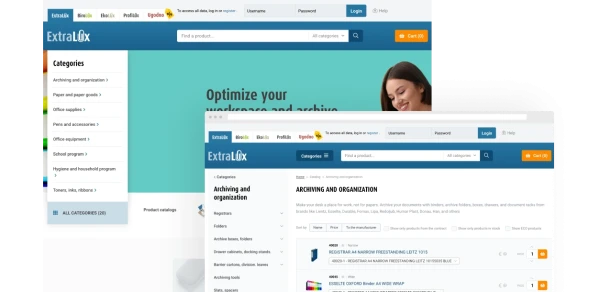
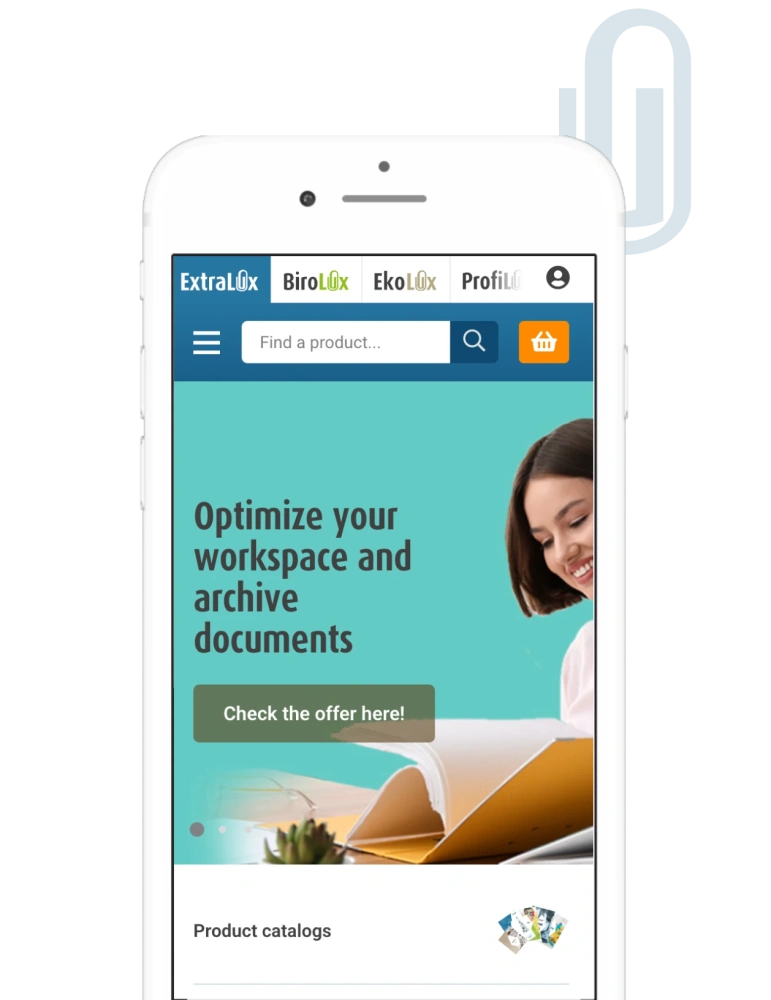
Our Sylius work: ExtraLux, Prosports, Fortrade, DZS, Gyllenhus.
Read the flagship story: ExtraLux on Sylius.com → Talk to our team →
We build and grow Adobe Commerce (Magento) storefronts for enterprise retailers — from discovery and UX through engineering, launch, and post-launch optimization. Our approach favors performance and maintainability over out-of-the-box defaults: custom module development, integration with various backend and 3rd party systems, and storefronts built to hold up under real retail traffic.
We build in Magento for retailers whose product catalog and checkout are fairly standard, but whose growth depends on running promotions and merchandising with frequent sales cycles and seasonal campaigns.
Proof in production: Merkur's Magento storefront — see the case study below.

Vue Storefront delivers exceptional shopping experiences with its mobile-first, headless approach. Key advantages include lightning-fast page loads (improving conversion rates by up to 30%), PWA capabilities for offline browsing, and framework-agnostic flexibility. Perfect for retailers seeking omnichannel consistency, brands requiring custom shopping journeys, and businesses transitioning from legacy systems. Its decoupled architecture allows for frontend updates without disrupting the backend, enabling rapid A/B testing and continuous UX improvements while maintaining backend stability.


We primarily utilize Lean and Waterfall methodologies, complemented by elements from other approaches as needed. For each project, we develop a customized strategy that addresses specific business requirements, technical constraints, and organizational factors. Our hybrid approach enables us to adapt to each project while maintaining structured governance, efficiency, and quality.
Security is embedded throughout our development lifecycle. As required by DORA and NIS 2 guidelines, we implement secure coding practices, conduct regular code reviews, perform automated security scanning, and execute penetration testing. Our development teams receive ongoing security training, and we maintain compliance with industry standards, including ISO 27001 and OWASP.
AI-assisted development typically reduces development time by 30-40% for standard components while allowing our team to focus on complex, high-value features. While the initial setup may require an investment, the long-term benefits include faster delivery, reduced maintenance costs, and higher-quality outcomes.
The short answer is: all of them. In reality, solutions with repetitive coding patterns, complex data processing requirements, or natural language interfaces typically see the greatest benefits. E-commerce platforms, content-heavy portals, customer service applications, and data-intensive systems are particularly well-suited for our AI-driven approach.
We adhere to strict data protection protocols that comply with GDPR and other relevant regulations. Our developers work with paid, GDPR-compliant AI tools — currently Claude and Gemini — chosen specifically for that compliance guarantee. As the AI landscape moves quickly, the specific tools may change, but the requirement doesn't: we only ever use AI tools that meet GDPR compliance. Client data used in our AI-assisted development process is anonymized, encrypted, and protected throughout.
We begin with a comprehensive assessment of your current technology landscape, identifying integration points and potential challenges. Our architects design integration patterns that minimize disruption while maximizing data consistency. We favor API-first approaches and implement robust error handling and monitoring to ensure reliable system interactions.
We track technical debt systematically through dedicated documentation and quality metrics. Our structured development process includes planned refactoring phases and continuous improvement initiatives. We provide transparency regarding technical debt implications and work with stakeholders to balance immediate business needs with long-term architectural health.
Knowledge transfer is integrated into our delivery model through comprehensive documentation and technical workshops. We create detailed functional specifications, including architecture diagrams, API specifications, deployment procedures, and operational runbooks, to ensure thorough and accurate documentation. Our handover process ensures your team has the knowledge and resources to maintain and extend the system independently.
Scalability considerations are addressed from the initial architecture phase. We implement horizontal scaling patterns, optimize database performance, and design for cloud-native deployments. Utilizing modular technologies, such as Symfony, we minimize strain when a solution upgrade or extension is required. Our solutions undergo rigorous load testing to validate scalability assumptions, and we provide clear scaling strategies for future growth scenarios.
For complex enterprise projects with well-defined requirements, we lean more heavily on Waterfall elements to ensure comprehensive planning and risk management. For innovative solutions with evolving requirements, we incorporate more Lean principles to enable faster feedback cycles and adaptation. Our methodology selection is a deliberate process based on project characteristics, client preferences, and risk assessment.