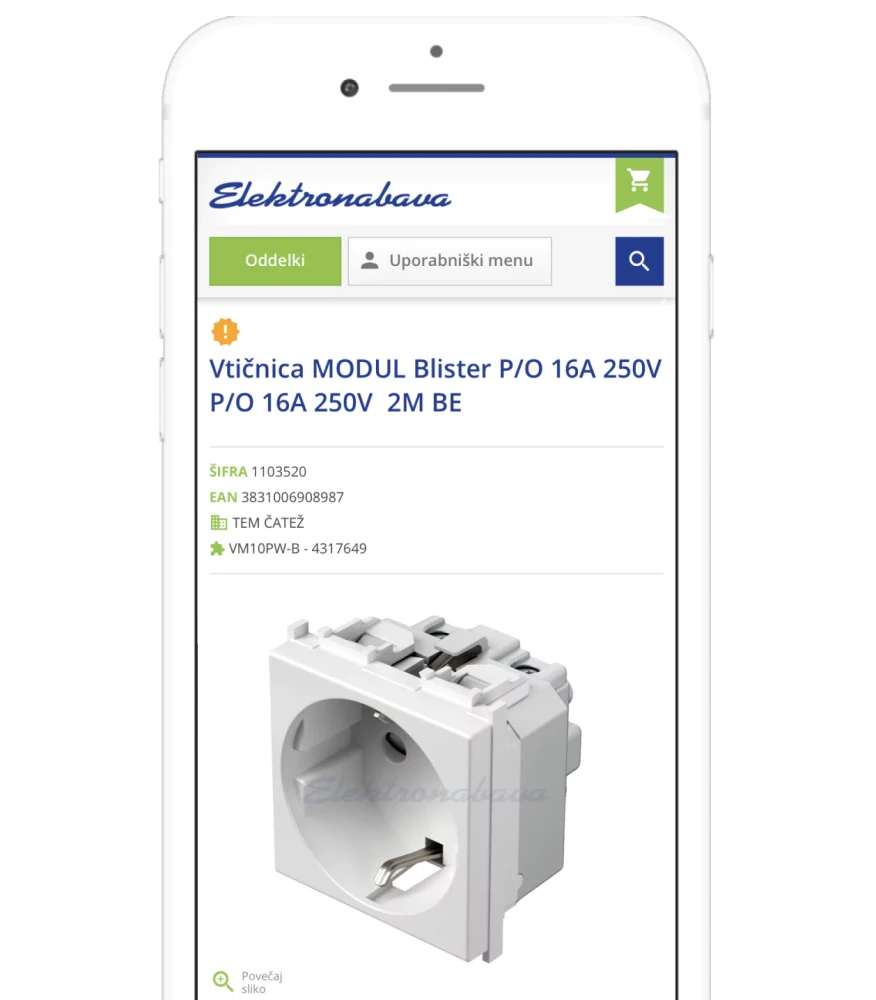
B2B Web Platforms Engineered for Complex Sales

From dealer portals and spare-parts commerce to product configurators and customer self-service — Creatim has engineered the digital platforms that European manufacturers like Kolektor, Domel, Unior, and NiceLabel depend on every day.


Our awards

  • Google Certificate
  • Nielson Norman Group
  • Project manager certification
  • IAAP logo
  • SIQ cert
  • IQNET Certificate

Platforms that outlive your CIO


A third of our manufacturing clients have been with us for eight years or more. Here's why enterprise buyers who could choose anyone in Europe keep renewing.

We deliver solutions, not surprises


Our project managers have delivered complex ERP-integrated portals on time and within budget for 25 years. We build in audit checkpoints every two weeks — so a €300k project never ends with a surprise. You can sign the milestone schedule into your procurement process without amending it mid-project.

Transparent communication — no black-box sprints


You'll have a named project manager who knows every integration point of your platform and is reachable by phone. You'll have a live dashboard, bi-weekly progress calls against defined milestones, and a clear escalation path. You'll never hear "we need two more weeks" on go-live day.

ISO 27001 security — built for IP-sensitive environments


Manufacturers handle bill-of-materials data, customer pricing agreements, and production capacity figures that cannot leak. Our ISO 27001 certification, zero-trust architecture, penetration-tested infrastructure, and GDPR-native data residency in the EU mean your legal team signs off in weeks, not months.

Long-term support — we're here in year seven

Most agencies disappear 90 days post-launch. Creatim's longest manufacturing relationships span over a decade. We handle peak-season traffic spikes, regulatory changes (EAA accessibility, GDPR amendments), new market expansions, and the product roadmap reviews that happen when the business evolves. We're staffed for the long arc.

Let’s Build Your Custom Agent

Ready to optimize your processes? Whether you need a smart guide for your website visitors or an efficiency tool for your employees, we can build the proof-of-concept.

Let's discuss your specific use case.
Two Creatim colleagues are sitting in a chair, actively communicating, each with a laptop in hand.

Frequently Asked Questions about B2B Ecommerce Solutions (FAQ)


B2B ecommerce is the digital sale of products or services between businesses. It enables customers, distributors and partners to place orders online, access personalized catalogs, view contract prices, check availability and manage repeat purchases.

B2C ecommerce is designed for individual consumers, while B2B ecommerce supports more complex business processes, such as negotiated pricing, bulk orders, approval workflows, multiple users per account, custom catalogs and ERP integrations.

A company needs a B2B ecommerce solution when it wants to reduce manual order processing, speed up sales, minimize errors, improve customer experience and enable business customers to order independently at any time.

Yes. B2B ecommerce is especially useful for companies with large product catalogs, repeat orders, complex pricing, multiple customer groups or sales through distributors, wholesalers and partner networks.

A good B2B ecommerce solution should include personalized catalogs, contract pricing, quick reordering, account-based user roles, approval workflows, ERP integration, stock visibility, order history and a self-service customer portal.

Yes. ERP integration is often essential in B2B ecommerce, as it enables synchronization of prices, stock levels, orders, customer data, documents and delivery statuses. This reduces manual work and improves data accuracy.

B2B ecommerce takes over routine orders and administrative tasks, allowing sales teams to focus on consulting, key account management and more complex sales opportunities.

No. B2B ecommerce does not replace the sales team. It supports them by automating repetitive tasks and giving customers a faster self-service buying experience.

The timeline depends on the complexity of business processes, product catalog size, integrations, required features and level of customization. More complex B2B ecommerce projects are usually delivered in phases.

The first step is to analyze existing sales processes, customer needs, product catalogs, pricing rules, order flows and backend systems. Based on this, priorities and implementation phases can be defined.