E-commerce
B2B Sales Online: Models, Partners and Sales Channels

Selling online in B2B is no longer just a question of adding another digital channel. For manufacturers, suppliers and distributors, it quickly raises a much more sensitive question: how can you sell online without putting existing partner relationships at risk?
Distributors, local retailers, installers, representatives and other partners have often spent years building relationships with customers. They know the local market, provide support, advise buyers, handle installation, service or on-site interventions. That is why direct online sales by a manufacturer can quickly create concern that partners will be pushed out of the sales chain.
But well-designed online B2B sales do not mean bypassing partners. Quite the opposite: a digital sales channel can include them, strengthen them and help them work more efficiently. The key is to define the right sales model, clear rules of cooperation and the role of each participant in the sales network from the start.
In this article, we explain how to digitalize B2B sales without upsetting your partners, which online sales models you can use and how a B2B portal can connect manufacturers, distributors and end customers.
Business buyers have become used to fast, transparent and independent buying experiences. They want information about products, prices, stock, delivery times and documentation immediately, not after several email exchanges, phone calls or spreadsheets.
These expectations are no longer limited to B2C. In B2B, buyers also expect to complete at least part of the buying process online: researching the offer, comparing products, submitting a request, checking availability or repeating an order.
Marketplaces, specialized distributors and digitally more advanced competitors are reinforcing these expectations even further. Business buyers quickly get used to suppliers who make their work easier. If they cannot find the information they need or place an order easily with you, sooner or later they will start looking elsewhere.
For manufacturers and suppliers, the question is no longer whether B2B sales will move online. The question is how to do it without disrupting the existing sales network.
Many companies are cautious about online B2B sales. Not because they do not see the opportunity, but because a large share of their revenue still comes through existing partners.
If a manufacturer starts selling directly online, distributors and retailers can quickly feel threatened. The questions that arise are very concrete:
These are legitimate questions. Partners are not just a sales channel; they often carry an important part of the company’s relationship with the market. That is why the goal of digitalizing B2B sales should not be to remove partners, but to organize the sales process better.
A properly designed online channel can give customers a better digital experience while allowing partners to keep their sales, advisory or service role.

Digital channels have many advantages, but they do not solve every customer need. An online platform can support catalogs, prices, orders, statuses and documents very well. What it cannot easily replace is local presence, expert advice, technical support, installation, service or the relationship a partner has with the customer.
This is exactly where distributors, retailers and local partners still have a strong competitive advantage.
Their role changes in digital B2B sales. There is less manual order entry, basic information sharing and administration. There is more consulting, support, local execution and relationship management.
In a digital model, partners can take over the tasks where they create the most value:
Online B2B sales therefore do not have to be a threat to partners. It can be a tool that removes routine administration and allows them to focus on higher-value work.
The biggest mistake is to develop an online channel separately from the existing sales network. If partners feel that the new platform is designed to bypass them, they will see digitalization as a threat.
That is why it makes sense to include partners already in the planning phase.
First, you need to define the rules: which customers belong to which partner, who handles inquiries, who issues the offer, who handles delivery, who provides support and how the sales value is shared.
Then you need to define the role of the online channel. It can be:
In the long term, the most sustainable solution is often one where the manufacturer provides technology, data, catalogs, integrations and part of the operational support, while partners retain the customer relationship, local presence and expert role.
The foundation for this type of model is a modern B2B portal that enables fast partner onboarding and the management of permissions, catalogs, prices, orders and statuses by partner or customer group.
In projects where sales take place through a partner network, technology should not serve only the manufacturer, but also the partners. Loftware is a good example of this: the focus was on how to include partners in the e-commerce process and enable more efficient digital cooperation with the manufacturer.
This type of solution supports the core idea of online B2B sales: the manufacturer can lead the digital experience and provide the platform, while partners retain their sales role, customer relationships and added value in the sales chain.
Online Business Generator
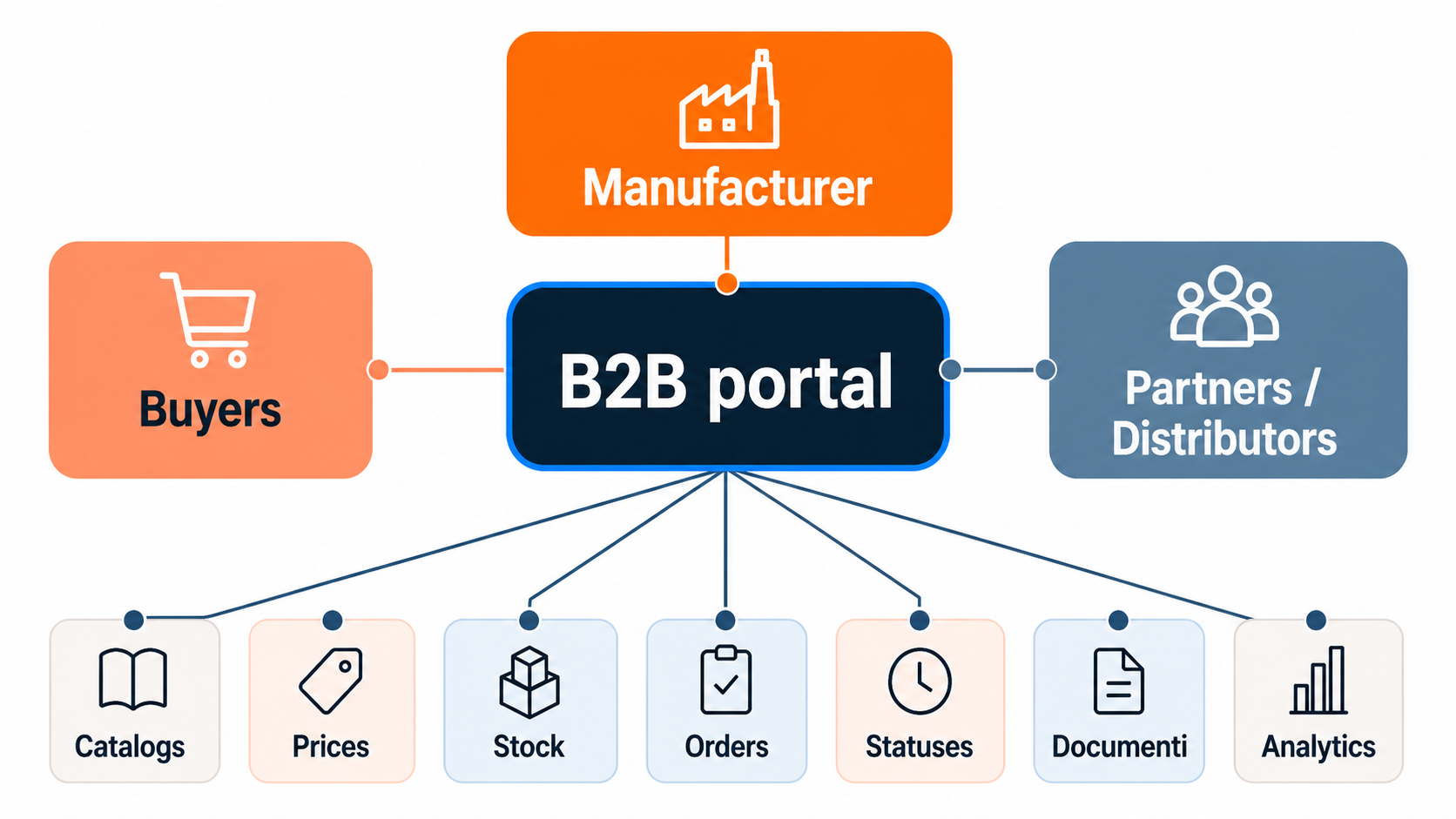
If you want to include partners in digital B2B sales, a B2B portal needs to support more than product display and order placement. It should work as shared infrastructure for the manufacturer, partners and customers.
A good B2B portal for partner sales should enable:
This type of portal reduces manual work, improves transparency and enables faster expansion of the sales network. Partners do not need to develop their own technology, while the manufacturer keeps control over data, processes and the quality of the digital experience.
Online buyers are not always looking for a single product. They often want to solve a complete problem.
For example, if a buyer is purchasing equipment for a project, they are not interested only in the basic product. They also want to know which accessories are compatible, what they need for installation, what documentation is available, who can help them choose and how quickly they can receive the goods.
That is why successful online B2B sales are rarely limited to individual products. They are more effective when you build a complete offer around your core product range.
This can include:
The goal does not have to be making a profit on every additional product. The main goal may be to sell your core product range. A complementary offer, better user experience and included partners make it easier for the customer to decide to order from you.
If partners already have their own online portals, they can be connected to your systems. This can make sense, but it is often not simple: data, prices, stock, orders and statuses need to be aligned.
But what if partners do not have their own online solution?
In that case, the manufacturer or technology owner can manage shared digital infrastructure for the entire partner network. Below are two common models.
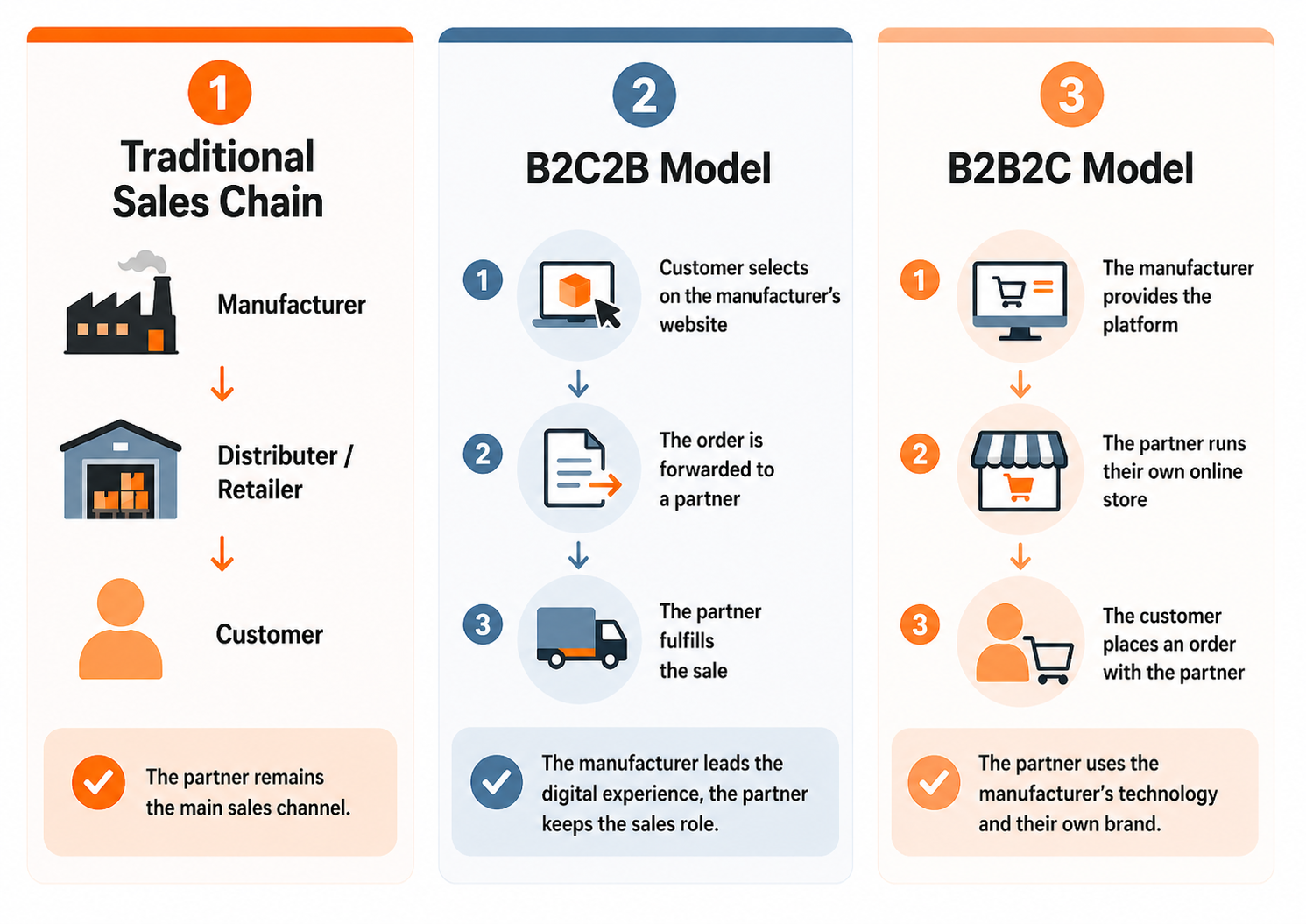
In the B2C2B model, the buyer chooses the product on the manufacturer’s website, while the purchase or execution is completed through a selected partner.
The buyer can choose the partner themselves, for example based on location, references or availability. Alternatively, the system can suggest the partner automatically based on geolocation, territory, product type or other rules.
The manufacturer leads the digital experience and presents the offer, while the partner remains included in the sales process.
This model is especially suitable when:
The advantage of this model is that the buyer gets a modern digital experience, while the partner does not lose their role. At the same time, the manufacturer increases the visibility of the offer and gains more control over the user experience.
In the B2B2C model, the manufacturer enables partners to run their own online stores or sales interfaces that function as an extension of the manufacturer’s digital platform.
For the end customer, the experience may look like the online store of a local partner. In the background, however, the manufacturer’s shared platform supports catalogs, product data, stock, payments, orders or logistics.
The partner can adapt the store to their own brand, while the manufacturer provides the technology, data and often part of the operational support.
This model is suitable when:
The advantages of this approach are significant. Partners do not have the cost of developing and maintaining technology, so they can focus on customers, consulting and additional services. The manufacturer gains better insight into sales, catalog usage, demand by region and the performance of individual channels.
If the model is designed correctly, everyone benefits: the buyer gets a better experience, the partner gets a better digital tool, and the manufacturer gets greater control over the market.
Sales channel conflict occurs when existing partners feel threatened by a new online channel. This often happens when the company does not define the rules clearly enough.
To avoid this, you need to answer a few key questions before introducing online B2B sales:
It is important that the online channel is not presented as a replacement for partners, but as a shared tool for better sales. You need to show partners what they gain: less administration, better data, more inquiries, faster ordering and better customer support.
Digitalizing B2B sales is successful when partners see themselves in the process, not when they experience it as a threat.
For many Slovenian companies, B2B sales are a key source of revenue. Many companies know how to develop and manufacture high-quality industrial products. The question is whether they can sell them just as well in a digital environment.
Online B2B sales can reduce dependence on a few large customers, expand the sales network, improve access to new markets and reduce order processing costs. At the same time, it provides better insight into demand, buyer behavior and the performance of individual sales channels.
Waiting has a cost. Buyers are getting used to suppliers that provide faster information, easier ordering and greater transparency. Partners also need tools that help them stay competitive in a digital environment.
With a smart online sales strategy that includes the entire partner network, you can strengthen your market position, reduce friction in sales processes and create a channel that supports growth instead of conflict.
If you want to move sales online without damaging relationships with partners, you first need to understand your sales network, existing channels, price lists, catalogs, buyers and processes.
Together, we can identify which online B2B sales model makes the most sense for your company, how to include partners and what role the B2B portal should play in the development of your digital sales channels.
More about B2B e-commerce solutions
B2B sales online means that a company enables business customers, distributors or partners to place orders digitally and access offers, prices, stock, documents and order statuses through an online platform or B2B portal.
A manufacturer can design the online channel so that partners are included in the sales process. Inquiries or orders can be directed to selected distributors, partners can be given their own online stores, or they can be provided with technology, catalogs, data and support for digital sales.
Sales channel conflict occurs when existing partners, distributors or retailers feel threatened by the manufacturer’s direct online sales. The solution is a clear strategy that defines roles, rules, customer segments and how orders are shared.
A B2B portal can connect the manufacturer, partners and customers in one sales system. It enables the management of catalogs, prices, stock, orders, inquiries, statuses and access rights by partner, region or customer group.
Not necessarily. Well-designed online B2B sales do not replace distributors, but strengthen them digitally. Partners can continue to provide local presence, consulting, installation, service and customer relationships.
Partners should ideally be included already in the planning phase. It is necessary to define who handles inquiries, who takes over the order, who is responsible for delivery or service, and how data, responsibilities and sales value are shared.
The B2C2B model means that the buyer chooses a product on the manufacturer’s website, while the purchase is completed through a selected partner or distributor. The manufacturer manages the digital experience, while the partner keeps the sales role.
The B2B2C model means that the manufacturer enables partners to use online stores or sales interfaces through which they sell to end customers. The manufacturer can provide technology, catalogs, stock or logistics, while the partner manages the customer relationship.
Digitalizing B2B sales makes sense when you have a larger sales network, repeat orders, complex catalogs, different price lists, multiple distributors or a lot of manual work in processing orders and inquiries.
The first step is to analyze the existing sales network, partner roles, customer types, price lists, catalogs and ordering processes. Then you define the online sales model, partner rules and the functionality the B2B portal needs to support.