E-commerce
B2B E-commerce: When and How to Implement It

In B2B sales, an online store is not just a “catalog on the web”. It is an ordering portal where customers log in, see their own assortment, contract-based prices and discounts, check stock availability and place an order in just a few clicks — without endless emails, spreadsheets and phone calls.
If you have at least a few regular customers, repeat orders or multiple price lists, B2B e-commerce can quickly make a practical difference: fewer order errors, faster processing, less administration for the sales team and a better customer experience, as buyers can place orders whenever it suits them.
In this article, we focus on implementing B2B trading in practice: when it makes sense, which processes it needs to support and how to choose a platform that adapts to the way you sell.
B2B e-commerce is a digital sales channel designed for business customers, where ordering takes place through an online portal or B2B store. The key difference compared to B2C is not only that companies are buying — but that each customer often has their own agreed terms: different prices, discounts, payment terms, delivery addresses, ordering restrictions or approval workflows.
In practice, a B2B e-commerce platform works as a self-service sales channel: the customer logs in, sees a personalized catalog, searches for products, checks stock or delivery times, adds items to the cart and places an order — often with the option to reorder or upload product lists, for example from Excel.
A typical B2B order flow can look like this:

You are probably familiar with the 80/20 rule: a smaller share of customers generates most of the revenue. But when it comes to costs, the opposite is often true. Many companies have a “long tail” of smaller customers who order less frequently or in smaller quantities, which makes manual order processing — calls, emails, spreadsheets, confirmations and retyping — quickly unprofitable.
But many small drops make an ocean. When you add up all these smaller purchases, they can represent an important share of revenue. The main issue is the cost per order. By introducing a B2B online store or self-service portal, you can automate part of the process — orders, prices, documents and statuses — and significantly reduce order processing costs, often by at least half.
Smartphones and digital channels have brought “always-on” expectations into B2B. Customers now want quick information about price, availability and delivery time — not to wait for an email response or a quote in a few days.
A B2B portal allows customers to access key information immediately, while the sales team can focus on larger opportunities, negotiations and customer relationships instead of answering basic questions.
The easier it is to order from you, and the less time and effort it takes for the customer, the more likely they are to buy from you — even if you are not the cheapest provider. A B2B store reduces friction in the buying process: customers can quickly find the right products, see their prices, place an order, track its status and access documents without additional coordination.
The ordering process is the heart of B2B e-commerce. The platform must support the way you sell and the way your customers buy — not force you into compromises. Before choosing a platform, write down your key scenarios: quick ordering by product codes, repeat orders, approvals, requests for quotation (RFQ), multiple delivery addresses, minimum quantities, agreed terms and similar requirements.
Rule of thumb: the platform should adapt to the process — not the other way around.
Modern B2B portals rightly take inspiration from the best B2C stores, because customers expect the same level of simplicity. When a partner logs in, they should “enter their own world”:
The experience must be easy to understand, secure and pleasant to use. Sales acceleration elements such as cross-sell, upsell and recommendations are also effective in B2B — especially when they are connected to past purchases and typical product combinations.
B2B sales are changing quickly: new product lines, new customer segments, multiple channels and new integrations. That is why you should choose a platform that enables:
Flexibility means lower risk and lower costs over the next two to three years.
A B2B e-commerce solution rarely lives on its own. It usually needs to be connected to ERP for prices, customers, stock and orders, often also to PIM for catalogs, attributes and images, and to CRM for customers and opportunities. The goal is reliable and selective data transfer, preferably close to real time — at least for data that affects the purchase, such as price, stock, delivery time and order status.
A good question for providers is: What can you integrate as standard, and where are the biggest risks usually found?
Desktop is not the only device — and often not the primary one. For many business users, mobile is essential because it is always at hand, especially for quick tasks such as checking order status, reordering or approving an order.
That is why the platform should not only be responsive, but should follow a mobile-first mindset: what does the customer most often do on a phone, and what do they do on a computer? The content and user steps should be adapted to these patterns, with shorter forms, quick buttons, clear navigation and simple search.
When choosing a platform, do not look only at the investment, but also at the payback period. ROI in B2B e-commerce usually comes from two sources:
Your implementation partner should help you prepare at least a realistic estimate: how many orders you process per month, how much time is currently spent on processing, where errors occur and what the potential is for increasing orders.
The platform alone will not deliver results if customers do not start using the channel. After launch, you need a plan for:
Because you know the segments, contracts and purchase history of registered customers, promotions can be much more targeted than in B2C.
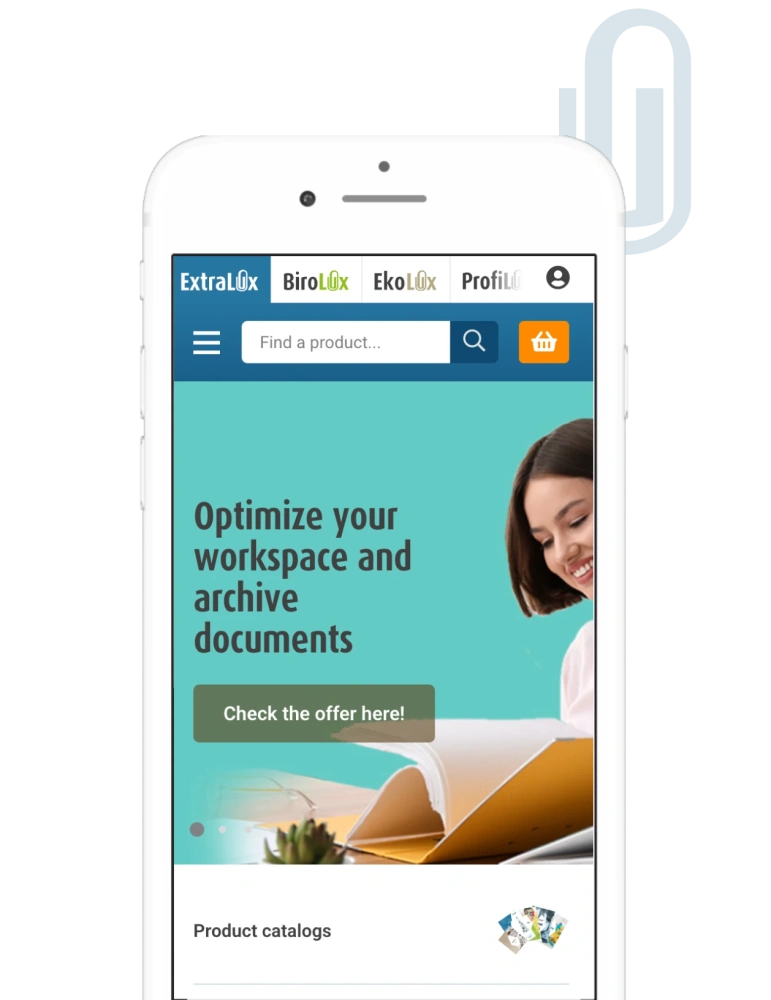
Extra Lux wanted to improve the user experience for business customers and at the same time optimize delivery costs. The starting point was very practical: when it comes to office supplies, orders often happen at the last minute, which means more urgent deliveries, more coordination and more administration. The goal was therefore to shift toward a more predictable, self-service way of ordering and supply management.
The solution was designed as a combination of B2B e-commerce and support for a “stock at customer location” model. Through the online interface, the customer manages selected products, monitors consumption and triggers stock replenishment. The system ensures that agreed terms and processes remain consistent and transparent. As a result, ordering and processing become standardized, while customers get faster access to information and a simpler path to placing an order.
The greatest value of this approach lies in automating routine tasks: less manual retyping, fewer errors, less chasing of order statuses and fewer urgent situations in logistics. The result is more predictable delivery, lower support costs and better service for the customer — without the feeling that they need to call or send an email for every small request.
70%+ of B2B orders online through a smarter distribution model
Thinking about implementing B2B trading? Together, we can review your sales processes, price lists, catalogs and integrations, and assess which solution would have the greatest impact on costs, ordering and the customer experience.
More about B2B sales
B2B e-commerce is a digital sales channel for business customers, where ordering takes place through a B2B portal or online store. It usually includes login, a customer-specific catalog, contract-based prices and processes such as user roles, approvals, documents and order statuses.
B2C is designed for end consumers and usually uses uniform pricing and simple buying journeys. B2B, on the other hand, must support specific business requirements: different price lists by customer, discounts, payment terms, multiple users within one company, approval workflows, multiple delivery addresses and integrations with ERP, PIM and CRM systems.
A B2B store is usually focused on online product ordering, while a B2B portal often supports a broader set of processes: access to documents, order statuses, stock levels, contract terms, approvals and customer communication. In practice, the two terms often overlap, as a modern B2B store functions as a self-service portal for business customers.
If you have different price lists, agreed terms or customer-specific assortments, it usually makes sense for prices and ordering to be available after login. A common approach is to have a public teaser catalog without prices, while prices, terms and ordering are available only to registered customers.
Most often through price lists and rules linked to a customer or segment, such as special prices, volume discounts, promotions, minimum quantities and payment terms. The key is that these rules are aligned with backend systems, most often ERP, to avoid errors and inconsistencies.
The most common integrations are ERP for customers, prices, stock, orders and documents, PIM for catalogs, attributes, images and specifications, and CRM for contacts and segmentation. Depending on the business model, integrations with WMS/logistics, EDI or specific systems for billing, contracts and service may also be needed.
Yes. A typical scenario is that a user prepares a cart, a purchasing manager approves it and only then is the order sent for processing. Limits by order value, user roles such as requester and approver, and permissions by department or cost center are also possible.
The timeline depends on the scope of functionality, data quality and, above all, integrations. Preparing product data for the catalog and connecting ERP, PIM or CRM systems usually takes the most time, along with aligning business rules such as prices, stock and processes.
The cost depends on the platform, required customizations, integrations and scope of functionality, such as customer-specific price lists, approvals, RFQ or special logistics. It makes sense to consider the total cost of ownership (TCO) and expected ROI, not only the initial investment.
Onboarding is essential: simple login, clear instructions, support in the first weeks and a clear reason to use the portal, such as faster ordering, order statuses, documents and personalized prices. A pilot with selected customers, followed by gradual rollout and clear communication of benefits — time savings, fewer errors and better transparency — usually works well.