Digital marketing
Alma and destinations: from local knowledge to more useful answers for travellers
When a visitor to a tourist destination is looking for information about parking, opening hours, transport or things to do in bad weather, a generic answer is often not enough. For AI to be truly useful in tourism, it needs high-quality, up-to-date and locally relevant information.
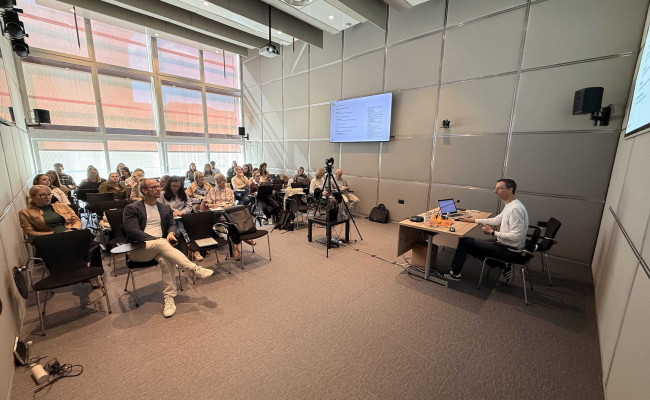
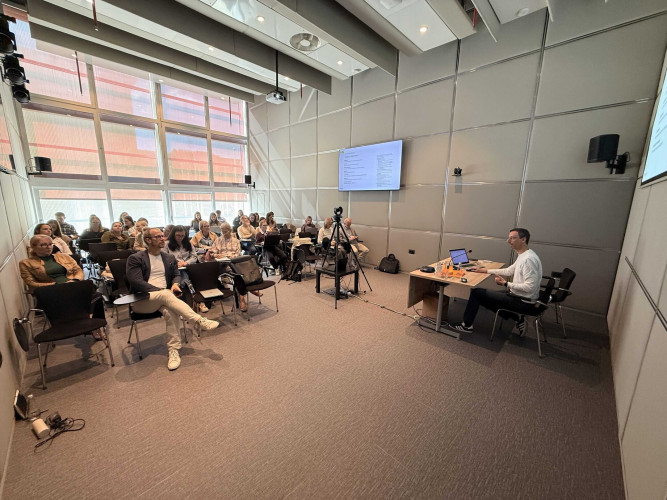
At the Digital Marketing Academy 2026, organised by the Slovenian Tourist Board, Creatim contributed a specialist programme on the use of AI in tourism, local knowledge and content preparation for generative AI systems.
Below, we highlight the key takeaways from the event: what the use of Alma tells us about visitors’ information needs, how destinations can contribute their local knowledge, and how content can be prepared for use in a generative AI environment.
Representatives of the Slovenian Tourist Board and Creatim presented insights from the use of Alma so far, examples of AI applications in destination environments, and opportunities for incorporating local knowledge into its answers.
The central question of the day was a practical one: how can we provide visitors with answers that take their specific circumstances into account and help them make a concrete decision? This might mean choosing an excursion, planning transport, finding parking or deciding what to do in bad weather.
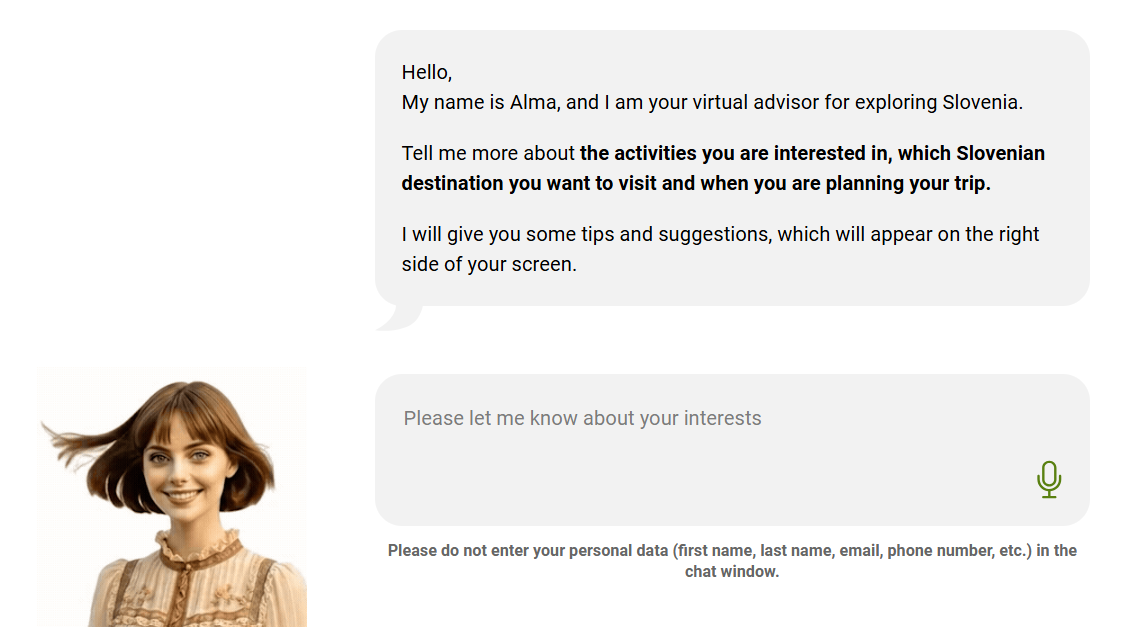
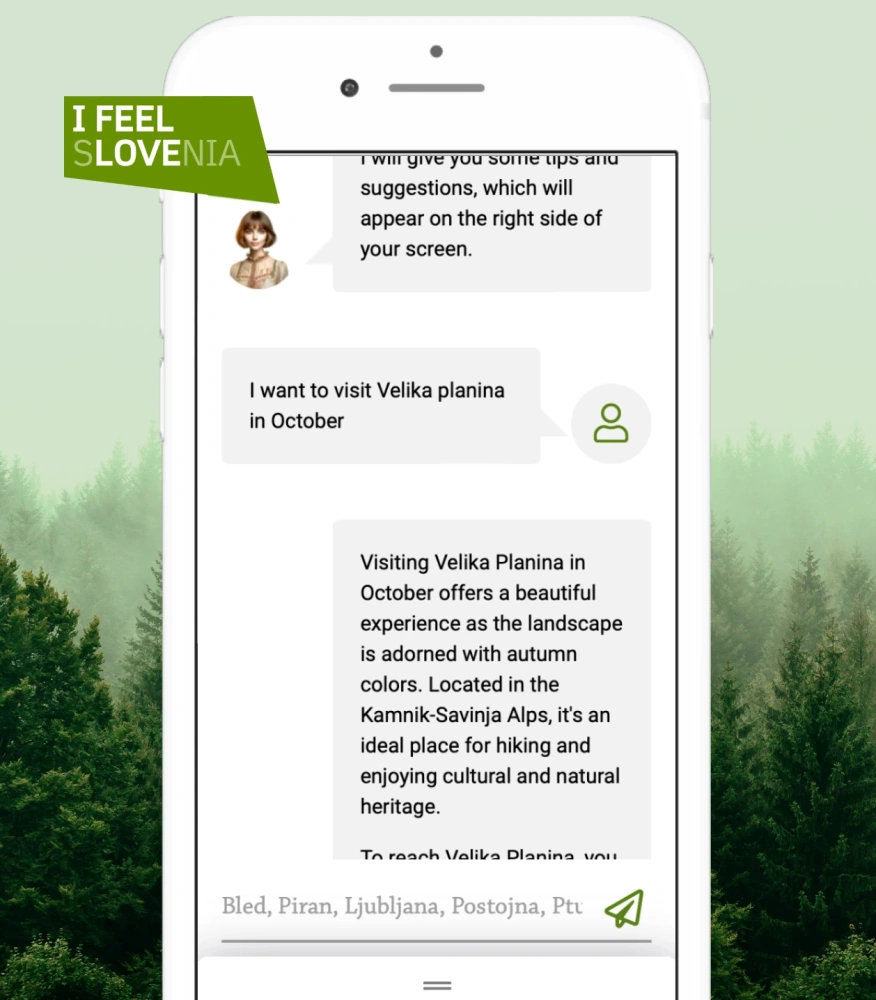
We also tested Alma live and used a specific user scenario to demonstrate how it responds to practical traveller questions. At the same time, we focused on the quality of information sources: what information is needed for a useful answer, how its accuracy can be verified, and how it can be kept up to date.
This is where destinations have an important role to play. They know the local specifics, conditions and owners of individual data sources best. Their involvement in “training Alma” therefore primarily means ensuring high-quality, verifiable and up-to-date local knowledge that can support more useful answers for visitors.
You can read more about the concept, development and operation of Alma in our case study.
During the practical Alma Destination Lab, participants started with questions that visitors frequently ask at their destinations.
Working in groups, they selected examples where a high-quality answer would be most helpful when planning or carrying out a visit. They then identified what information would be needed, where it could be sourced, who is responsible for maintaining it and how often it needs to be updated. Based on this, they also prepared a proposal for Alma’s ideal answer.
The workshop showed that a good answer requires more than just the information itself. It is also important to know where it comes from, who maintains it and how quickly it can change.
Alma’s use so far indicates that visitors often continue conversations with follow-up questions and explore their options in greater detail. Multilingual access to information is also important, as the digital travel assistant is used by visitors from a variety of markets. The Slovenian Tourist Board has shared more about Alma’s usage results and plans for its further development in its official news release.
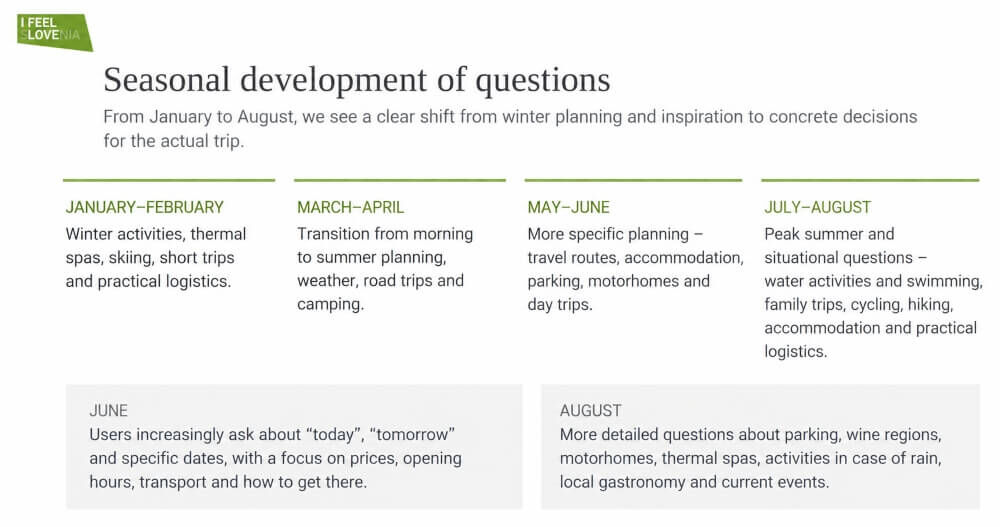
One noticeable shift is from “What should I visit?” to “How can I actually make it happen?”
Visitors are not only interested in ideas for excursions, attractions and experiences. They also need practical information: how to get somewhere, where to park, what is open, which transport options are available and what makes the most sense given their circumstances.
The closer they get to the actual visit, the more important time-sensitive local information becomes. Travellers are not just looking for a general recommendation, but for a feasible answer for their specific dates, travel companions, weather conditions and mode of transport.
Our experience so far also suggests that clear, structured and personalised answers are the most useful. Information that changes frequently presents a particular challenge. This is where destinations can make an important contribution by providing reliable local sources, knowledge of local specifics and regular content updates.
Visitors’ questions can also provide valuable input for improving destination websites. They show what information travellers are looking for, where existing answers are not specific enough and which content may need to be expanded.
The Academy also presented the Slovenian Tourist Board’s plans for a more structured integration of destination content and the development of a Training Alma module within STO’s business profile.
The planned module will allow administrators to add local information and review and improve answers where additional or more precise knowledge is needed.
In this context, “training Alma” primarily means adding, verifying and maintaining the information on which its answers are based. Destinations will therefore be able to contribute their local knowledge while taking care of its quality and accuracy over time.
The Slovenian Tourist Board is also preparing the necessary organisational, technical and legal framework for integrating Alma into destination websites. The next steps for interested destinations are planned for 2027.
Another important part of Alma’s further development is monitoring visitor questions and feedback.
These questions reveal what travellers are actually looking for, where they encounter difficulties and where existing information is not clear or specific enough. The findings are therefore useful on two levels: for improving Alma’s answers and for improving destination website content itself.
The process is connected: we identify an information gap, improve the content or source, test the answer again and monitor whether the change helps visitors more effectively.
This was also the focus of the GEO (Generative Engine Optimization) workshop, where participants explored how to prepare destination content for a generative AI environment.
As with traditional search, the quality of AI output depends on the quality of the information it can access. Clear, structured, specific and up-to-date content is therefore useful both for website visitors and for digital assistants that rely on this information when generating answers.
How well does Alma handle the kinds of questions you might ask when planning a day trip or a journey through Slovenia?
You can ask for trip ideas, activities based on the weather, transport options, attractions, practical information or recommendations tailored to your preferences.
Every question is also a useful test of how the combination of artificial intelligence and high-quality local knowledge can help travellers get the right information at the right time.