Digital marketing
How to Use Artificial Intelligence in Content Marketing in Practice

Artificial intelligence (hereinafter also referred to as AI) has become a constant in digital marketing in recent years. Tools that help with idea generation, drafting, optimization, and content reuse promise greater speed and scale. And yet, experience shows that more content does not necessarily mean better results.
Today, the question is no longer whether to use AI tools, but how to integrate them into the content process in a way that preserves quality, relevance, and brand identity. This article is a practical guide that shows how to use artificial intelligence step by step – from the initial idea to publishing and further content reuse – in a way that delivers real results.
Artificial intelligence has become extremely accessible. What was recently reserved for specialists is now available to everyone: idea generation, article structuring, draft writing, and social media summaries. This enables teams to produce more content faster.
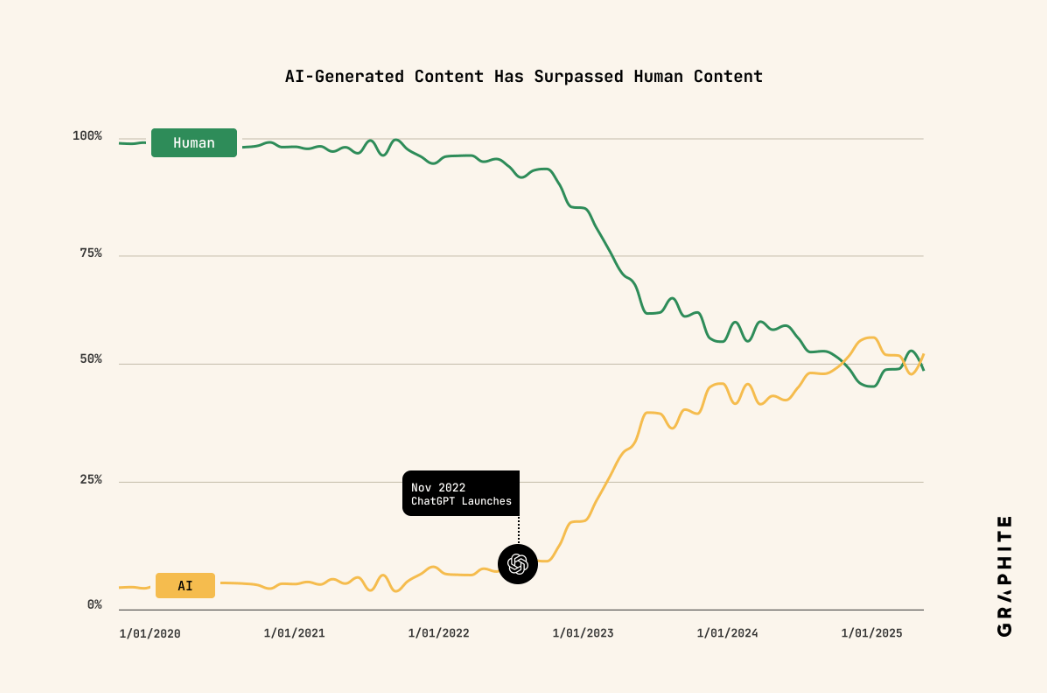
Research by graphite.io shows that approximately half of the articles published on the internet today are written using artificial intelligence.
Source: graphite.io
As the chart shows, after the release of ChatGPT in November 2022, the number of AI-generated articles increased sharply, but in the past year this growth has stopped and the trend has not continued. Instead, the share of AI-generated articles has remained relatively stable over the last 12 months.
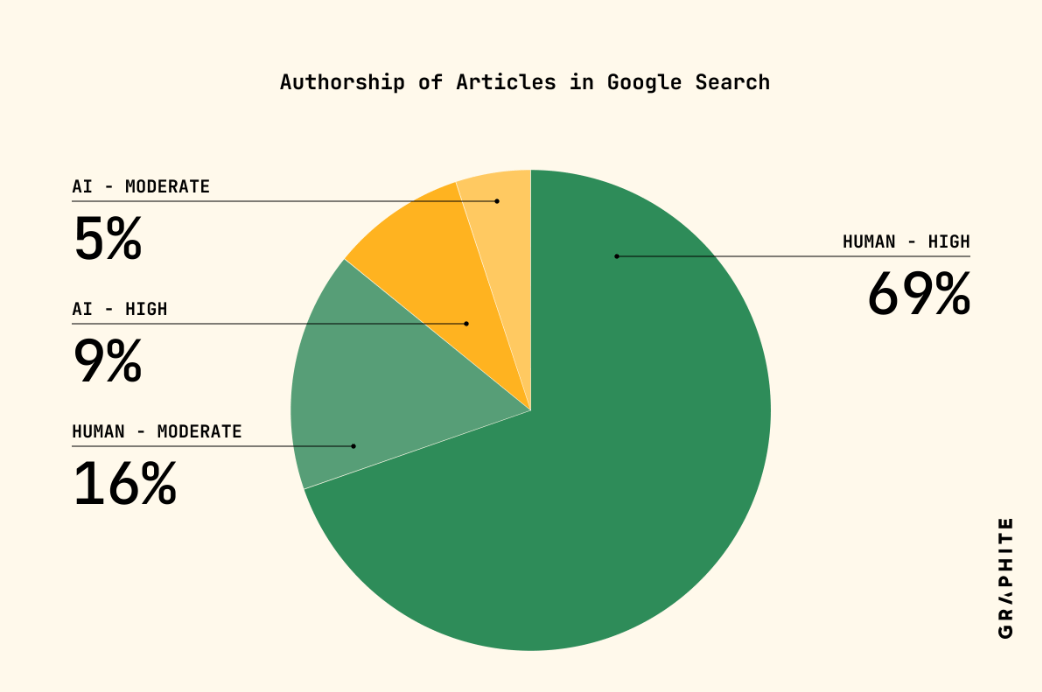
Why is that? The answer comes from another graphite.io study, which found that the most successful articles by far are those written by humans. Both ChatGPT and Perplexity cite human-written articles in 82% of cases and AI-generated articles in only 18%.
Source: graphite.io
This research refers to articles that are fully generated by artificial intelligence, which we strongly do not recommend. There is a better option – content created with the help of artificial intelligence (AI-assisted content). This is a strategy where a tool produces a draft, and an editor then reviews, edits, and adds a personal touch and experience.
We will explain how to do this as effectively as possible below.
The most common mistake when introducing AI is that teams start with the question: “Which tool will we use?” The right question is: “What do we want to achieve with our content?”
Every piece of content has a purpose – to increase awareness, build trust, generate leads, or support sales. If this is not defined in advance, artificial intelligence cannot work meaningfully. It will generate fluent text, but it will not be goal-oriented. In practice, this means that every project must have a clear brief: who it is for, which stage of the decision-making process the reader is in, and what we want them to do after reading. Only on this basis can AI help with ideas, structure, and writing.
The most effective approach is based on a clear division of roles: artificial intelligence provides speed and structure, while humans provide strategy, context, and final responsibility. AI can suggest, humans decide. AI can write a draft, humans turn it into professional, relevant content.
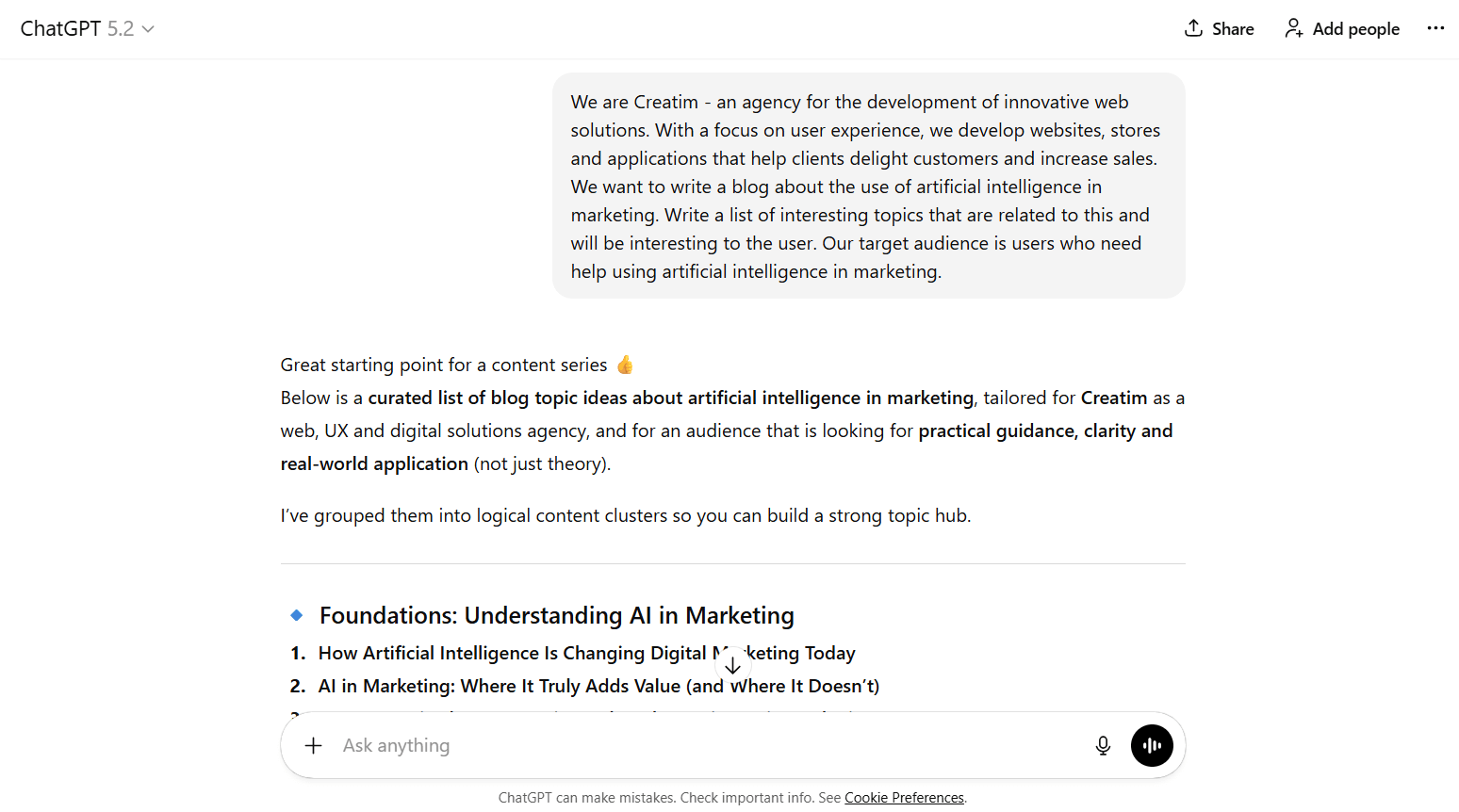
Every good content project starts with an idea. Artificial intelligence is extremely useful at this stage, as it helps expand the core topic, discover subtopics, and gather questions that interest the target audience. For example, if the main topic is “content marketing,” AI can help break it down by industries, stages of the buyer’s journey, or formats (guides, comparisons, case studies).
Example of a prompt we enter into a tool (in our case, ChatGPT) to help us prepare ideas and interesting topics for our target audience:
In addition, AI can generate a list of questions that users have – and these questions are often the best basis for articles, guides, and FAQ content. However, humans must take a crucial step: deciding which topics are business-relevant and which are merely interesting but do not support company goals. AI can offer many ideas, but it cannot determine priorities.
Properly used, AI does not replace strategic thinking, but accelerates it: it helps turn scattered ideas into a structured content plan.
Good structure is the foundation of good content. Even the best writing style cannot save an article that is confusing or poorly organized. That is why the structuring phase is crucial – and this is where artificial intelligence is extremely helpful.
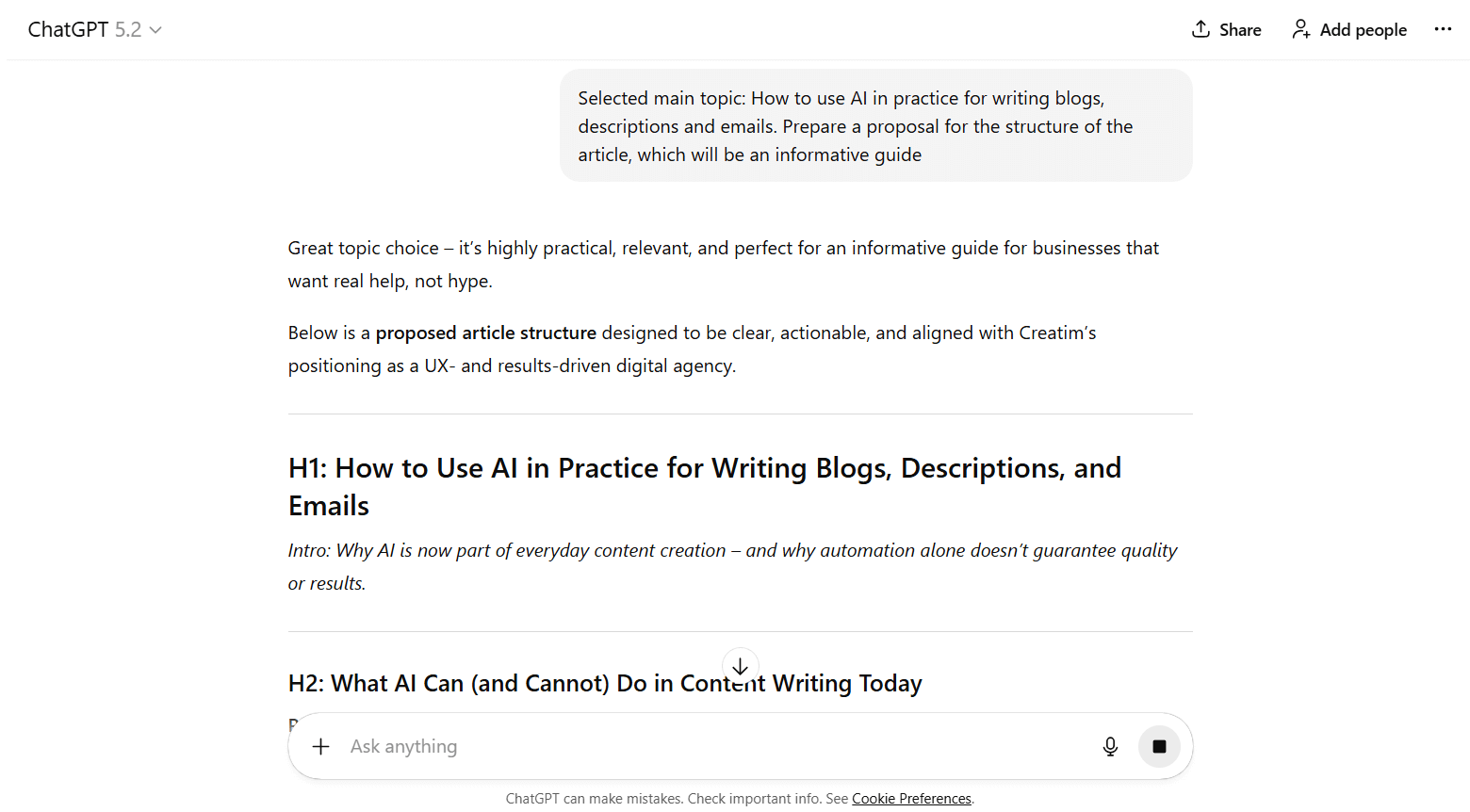
Based on the goal and a short brief, AI can suggest a division of the article into sections, subheadings, and key points. This quickly gives us a framework that we then edit and adapt to our strategy.
Already at this stage, we also think about the purpose of the content: whether it is an informational guide, a comparison article, or content that supports a purchasing decision.
Example prompt:
Structure is not just about organizing text, but about deciding which information is truly important for the user and in what order it will be easiest to understand. AI helps set the basic framework, but the final form must always be confirmed by a human.
Writing is the phase where AI most clearly demonstrates its speed. A first draft can be created in minutes, significantly reducing the time from idea to finished text. However, this is also where the greatest risk of generic content arises.
Raw AI text is almost always too general. It says that “AI improves efficiency,” that “content quality is important,” and that “it is necessary to know the target audience” – all of which are true, but they do not say anything new. That is why human intervention is essential.
An editor or expert must enhance the draft with practical examples, concrete data, results, and a clear point of view. Instead of abstract statements, the content must answer: what does this look like in practice, why does it work, and what does it mean for the reader. This layer of experience and context is what distinguishes generic text from content that builds trust and authority.
Once the text is written, its real impact is often decided. Artificial intelligence can help with headlines, meta descriptions, short summaries, and improving readability. It can offer multiple versions, enabling faster testing and optimization.
However, editorial review is still essential. The content must speak the language of the target audience, maintain the brand voice, and remain factually accurate. Before publishing, it is necessary to verify facts, clarity of structure, and alignment of the call to action with the content’s goal. AI can speed up this step, but it cannot take responsibility for it.
One of the greatest advantages of artificial intelligence is the ability to reuse content. From one high-quality article, you can quickly create social media posts, newsletter summaries, video script drafts, or presentation outlines.
Instead of writing from scratch each time, AI helps adapt the same message to different channels and formats. Even in this step, the editor must review and adjust the text.
Example prompt:
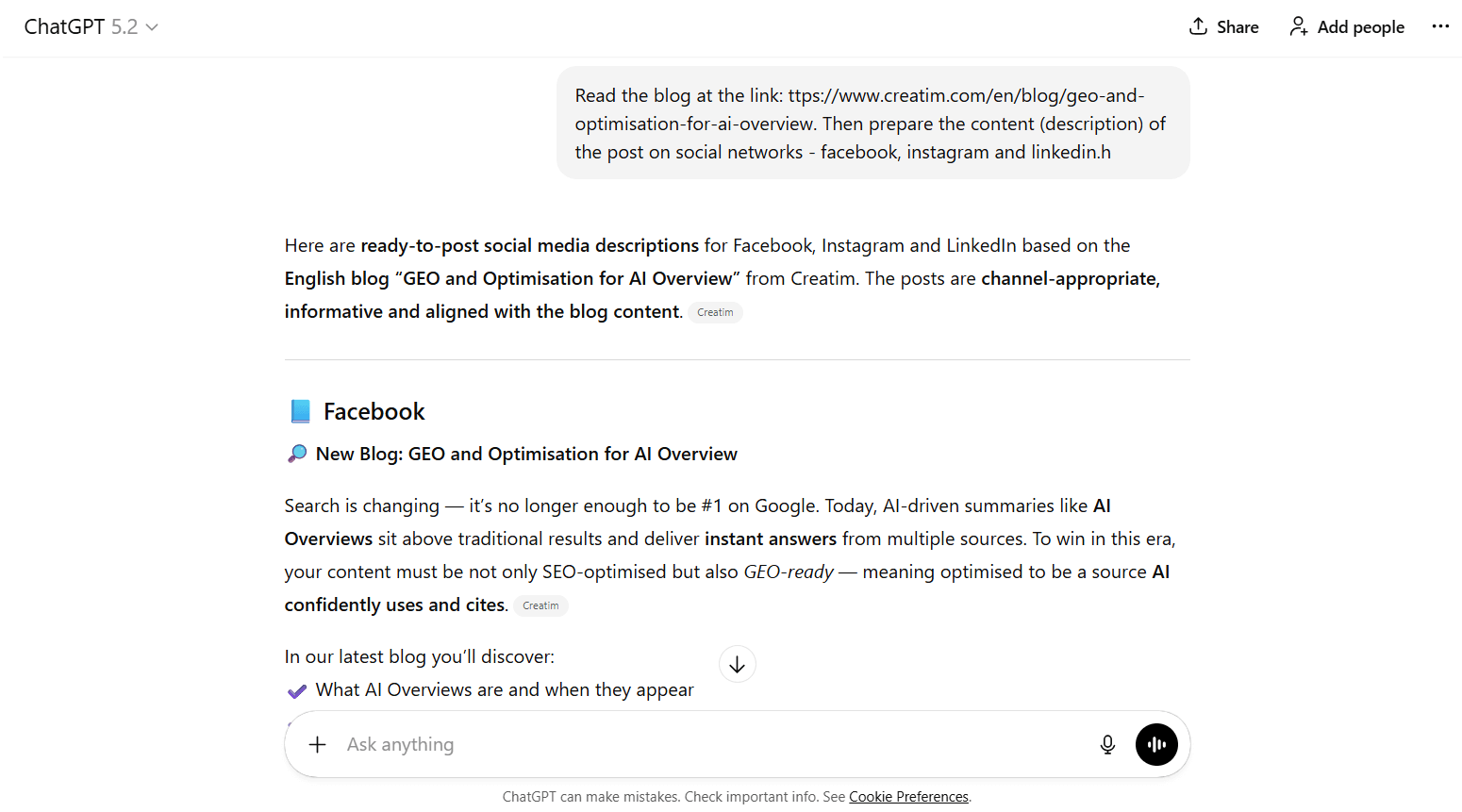
This significantly increases the reach of the content and the return on time invested. Content no longer lives only on the blog, but becomes the core of the entire communication strategy.
Because AI works based on patterns, general formulations, repeated phrases, and a “neutral” tone often appear. Such content is technically correct, but it does not stand out and does not build authority.
The signs of generic AI content are recognizable: lack of concrete examples, absence of data, no clear viewpoint, and the feeling that the same text could have been published by any company.
The solution is always the same: add experience, numbers, context, and a clear opinion.
Instead of abstract statements, content should show how a solution was used in practice, what the result was, and what it means for the reader. Editorial review is not a formality, but a crucial step where the text gains personality and professional weight.
HubSpot, in its article on using AI in content marketing, identifies the following key challenges:

Artificial intelligence does not replace good strategy, a deep understanding of users, or professional expertise. However, it can significantly accelerate all of these elements. When embedded in a clear process, it helps teams move faster, test more ideas, and spend more time on what truly creates value: thinking, insight, and quality.
The goal of using AI in content marketing is not more content, but better content in less time. The real value emerges when technology is combined with human expertise, UX thinking, and a strong understanding of your business objectives. If you want to use AI in a way that delivers measurable results — not just higher output — we’re here to help.
No. AI can speed up research, structuring and drafting, but it cannot replace human expertise, strategic thinking, or brand voice. The best results come from AI-assisted content, where humans edit, refine and add real value.
Not inherently. Search engines care about quality, relevance and usefulness—not who wrote the content. However, unedited, generic AI text can hurt rankings. AI content must be reviewed, enriched and aligned with user intent.
Use AI to generate topic ideas, outlines and first drafts. Then enhance the content with your own insights, examples, data and clear positioning. AI should support your workflow, not define your final message.
Yes. AI can quickly create multiple versions of descriptions, highlight features and benefits, and adapt tone for different audiences. However, human review is essential to ensure uniqueness, accuracy and brand consistency.
Yes, if used responsibly. AI can help with subject lines, structure and personalization, but sensitive data should never be shared with AI tools, and all emails should be reviewed for tone, accuracy and compliance.
Always add human input: real examples, measurable results, expert insights and a clear point of view. Editorial review is the key step that transforms AI drafts into credible, high-quality content.
The biggest risks include inaccurate information, plagiarism, bias in generated content, and data privacy concerns. These can be managed with fact-checking, plagiarism control, clear internal guidelines and responsible data use.
Start with a clear process: define goals, understand your audience, create a content brief, use AI for drafting, and rely on human editing before publishing. Tools come second—strategy comes first.