Digital marketing
GEO Optimization: How to Stay Visible in the Age of AI Search

The way people search for information online has changed significantly in recent years. Users are no longer looking only for lists of links, but for direct and clear answers. Generative models and AI-powered search engines have become the interface between users and content, placing traditional SEO approaches in front of new challenges.
In this context, optimization for generative search engines, or GEO optimization (Generative Engine Optimization), is emerging. This approach goes beyond traditional search engine optimization and focuses on how AI systems understand, select, and summarize online content.
Traditional search engines presented users with a list of results from which they had to choose the most relevant option themselves. Generative systems reverse this logic: users receive a ready-made answer, often without needing to click through to the source website.
For brands, this brings important changes:
SEO does not lose its importance, but it is no longer sufficient on its own.
Neil Patel notes that AI search generates significantly less traffic than traditional search, but a disproportionately higher share of sales, as users coming from AI platforms are already much further along in the decision-making process. While research in traditional search happens primarily on websites, AI platforms keep most of the research within their own interface, which means that the clicks that do occur are far more conversion-focused.
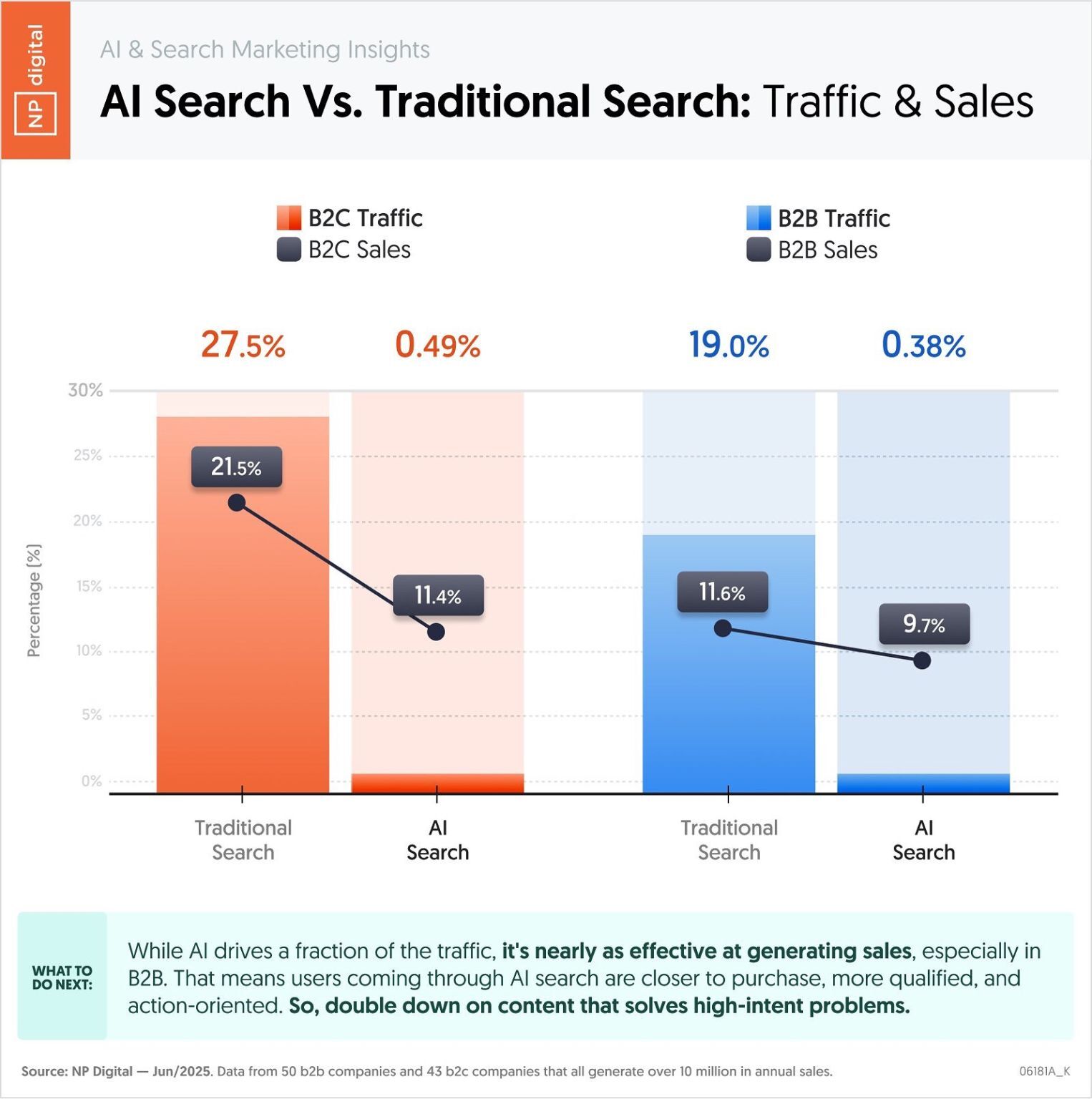
Source: neilpatel.com
GEO optimization is the process of adapting content so that generative models (LLMs, AI-powered search engines, conversational interfaces) can more easily understand it, evaluate it as trustworthy, and use it when generating answers.
While SEO optimizes content for algorithms that rank pages, GEO optimizes content for systems that:
It is important to emphasize that GEO does not replace SEO, but rather builds on it. Without technically sound and properly indexed content, GEO has no foundation.
As highlighted by Search Engine Land, the key difference between SEO and GEO is not whether content is found, but how it is used. While SEO optimizes pages to rank as high as possible in SERPs, the goal of GEO optimization is for generative models to recognize content as a relevant source, summarize it, and, when appropriate, cite it in the final answer delivered to the user.
This shift means that brand visibility is no longer necessarily connected to a click, but rather to a mention, citation, or summary within an AI-generated response, which requires a different content strategy.
With SEO, the main goal is to achieve high rankings and generate clicks. GEO, on the other hand, aims for content to be:
SEO still relies on keywords, page structure, and backlinks. GEO places greater emphasis on meaning, context, entities, and topical depth.
| SEO | GEO |
| Goal is high rankings in search results | Goal is for AI to use content in its answers |
| User clicks a link | User receives an answer without clicking |
| Search engine shows a list of results | AI composes a summarized answer from multiple sources |
| Keywords are important | Meaning and context are important |
| Focus on website traffic | Focus on visibility and mentions |
| Success measured by rankings and visits |
Success measured by inclusion in AI answers |
| Content written for search engines and users | Content written for users and AI |
| SEO brings users to the website | GEO brings the brand into the answer |
A successful GEO strategy is built on content signals that enable AI systems to clearly understand, trust, and use the content. The following pillars, summarized from Search Engine Land, represent the key areas every piece of content must address if it aims to be included in AI-generated answers.
In GEO optimization, content must be clear and logically organized. Generative systems look for clear facts, consistent terminology, and meaningful connections between ideas. When content clearly communicates what it is about and what it aims to convey, AI can more easily understand it, trust it, and reuse it when generating answers.
AI systems no longer operate only on keywords, but recognize concrete entities such as brands, people, products, and concepts. If these entities are named inconsistently or ambiguously, content may be misinterpreted. A clear entity identity, supported by context and consistent usage, significantly increases the likelihood of correct understanding.
❌ Bad example: “Creatim offers various digital services and helps companies improve their online presence. The team works on websites, design, and technology, providing modern solutions for different clients. With experience in digital projects, Creatim supports businesses in achieving better results online.”
✅ Good example: “Creatim is a Slovenian digital agency specializing in the development of innovative web solutions with a strong focus on user experience. The agency plans and develops websites and digital products for both domestic and international clients, helping improve user experience, increase user engagement, and support sales growth. Operating at the intersection of web development, UX design, and digital strategy, Creatim helps companies build digital solutions tailored to modern user expectations and business goals.”
Content that can be quickly broken down into meaningful parts is far more usable for AI. Long, dense paragraphs without clear conclusions hinder comprehension. Generative systems favor content where claims are clear, answers are concrete, and information can be easily verified and summarized.
AI systems assign greater weight to content that clearly shows where information comes from. Visible authorship, credible sources, and clear context reduce the risk of misinterpretation and increase trust.
Content freshness matters, but only when date signals are clear and aligned. If publication dates, update dates, and metadata conflict, AI may struggle to determine relevance. Clear labeling of updates or evergreen content helps AI understand when and why information remains relevant.
What happens outside your website plays an important role in GEO optimization. Mentions in trusted media, professional publications, and other credible sources signal that content is not merely self-promotional. Consistent mentions across high-quality sources increase AI’s confidence in an entity’s credibility.
AI systems collect signals from various digital environments, not just websites. Consistent brand presence across social media, videos, podcasts, and professional communities helps build a broader understanding of who you are and where your expertise lies—strengthening perceived authority in AI answers.
Users turn to AI with very specific questions, often while comparing options or making decisions. Content that addresses these questions clearly, honestly, and thoroughly is more likely to be recognized by AI as useful. This is a natural extension of classic SEO’s focus on user intent, now realized within AI-generated experiences.
Although the core principles of GEO remain the same, generative models are not all designed alike. They differ in how they handle freshness, authority, structure, and context. Understanding which signals matter most for different platforms is therefore essential.
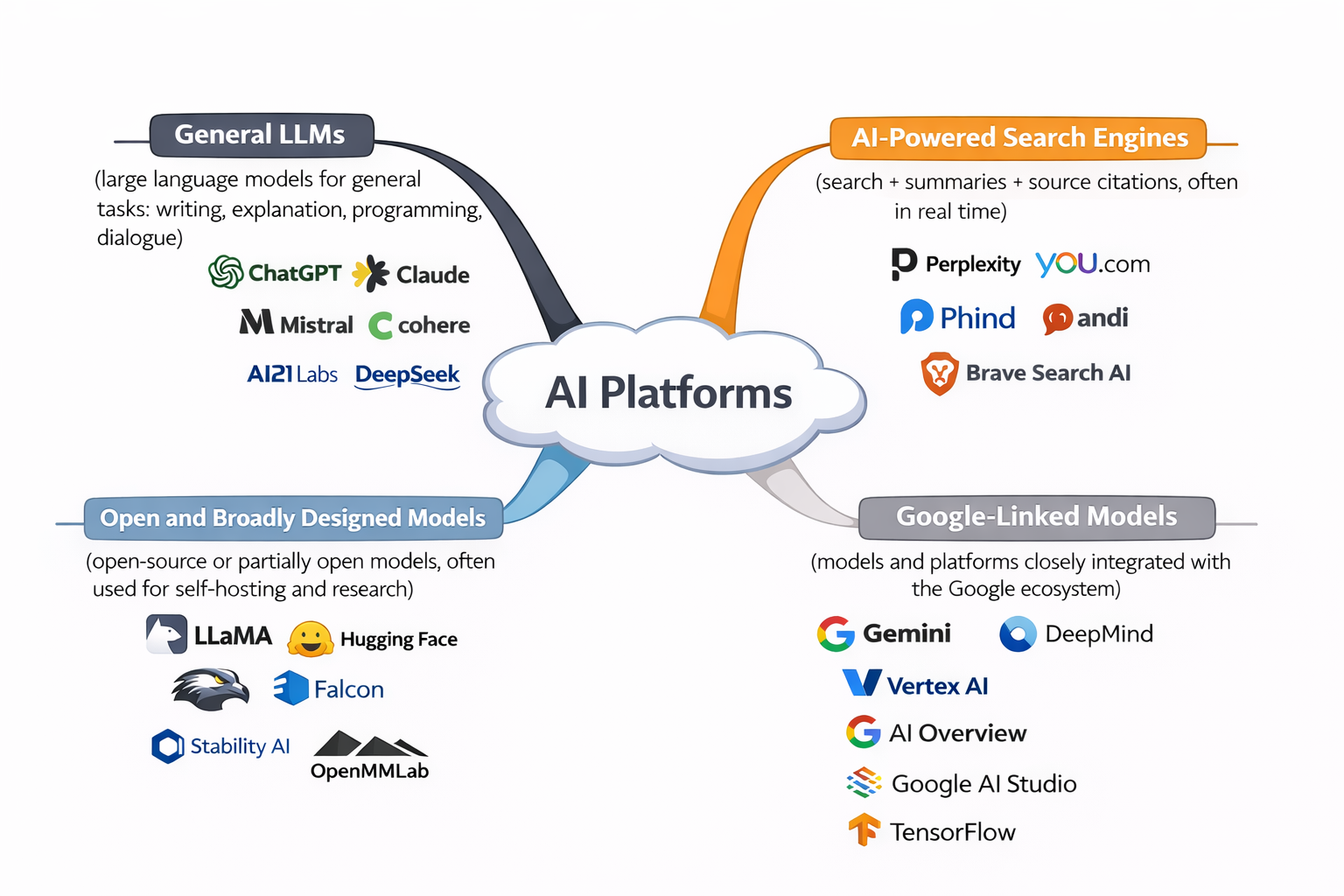
These models interact with users conversationally and strongly prioritize trust and overall source authority. They favor content that is clearly written, expert-driven, and consistent over time.
Key optimization factors include:

AI-powered search engines resemble traditional search engines but deliver direct answers instead of lists of links. GEO here is closely tied to citations and content freshness.
Important factors include:
This aligns perfectly with the GEO principle of “being cited, not just found.”

These models use very broad data sets and are not tied to a single ecosystem. As a result, they favor semantically rich content that serves a wider audience.
Key considerations include:
This group highlights why GEO fundamentals—structure, context, and user value—are so important.
These systems are directly connected to Google’s search ecosystem. They do not replace traditional search, but enhance it with generative answers.
Key factors include:
AI Overview is a clear example of this approach, showing that high rankings alone are no longer enough. Content must be high-quality and easy to understand for AI to include it in a generated answer. More about how AI Overview works and how to prepare for it is explained in the linked article below.
The good news is that most content does not need to be rewritten from scratch. In many cases, it is enough to enhance existing pages by:
Pages that already perform well in SEO often have the greatest GEO potential.
Measuring GEO success is not simple, as traditional KPIs such as SERP positions, CTR, or organic traffic no longer tell the full story required by AI-driven search. Generative models like ChatGPT, Gemini, or Perplexity often deliver direct answers instead of result lists, meaning content can be used without a website click. This creates a “zero-click” environment where traditional metrics fail to reflect true visibility or brand impact.
It therefore makes sense to track new metrics that better reflect GEO performance, including:
Some GEO signals remain difficult to measure precisely, as AI systems offer limited transparency into why certain sources are chosen. As a result, GEO measurement today often combines trend analysis, visibility, and contextual presence rather than relying solely on raw numbers.
GEO optimization is not a passing trend, but a natural evolution of SEO in an environment where answers are increasingly delivered through AI systems. Visibility today is no longer just about rankings, but about trust and inclusion in AI-generated responses.
If you want to explore how GEO can be effectively integrated into your content and SEO strategy and increase your brand’s impact in the age of AI search, get in touch with us—we’ll be happy to guide you through the next steps. For a tailored assessment of your opportunities, book a free consultation via our contact form.
GEO (Generative Engine Optimization) is the process of optimizing content for generative AI systems so they can understand, trust, and use it when generating answers.
SEO focuses on rankings and clicks, while GEO focuses on inclusion in AI-generated answers. GEO builds on SEO by emphasizing context, entities, and authority.
No. GEO does not replace SEO — it complements it. Strong technical SEO and indexable content are still the foundation for effective GEO.
Content is GEO-ready if it is clearly structured, uses consistent entities, answers real user questions, and provides clear sources and context.
GEO performance is measured through AI mentions and citations, brand presence across AI platforms, and indirect impact such as branded searches and lead quality.
No. In most cases, existing content can be upgraded with clearer answers, improved structure, and deeper context to achieve strong GEO results.