Digital marketing
Optimisation for AI Overview


If you want to win in Google’s “AI era”, the goal is no longer just “being #1 on Google”, but also being mentioned as a source in AI Overview. This is the new visibility battleground: the user gets an answer immediately, and you have to earn the click by being among the sources Google chooses.
If you work in marketing, you’ve probably recently come across the acronym GEO (Generative Engine Optimization). It’s a more modern marketing approach focused on optimising content for generative search engines and AI summaries (e.g. Google AI Overview, as well as environments where users ask questions directly to AI).
In this blog, we’ll focus on optimisation for AI Overview. You’ll learn:
AI Overviews are AI-generated summaries of results for your search query or keyword entered into Google Search. They appear above the organic results and can also appear above paid ads.
We can answer what AI Overview is by using AI Overview itself; it is a “feature that uses generative artificial intelligence to provide instant, summarised answers at the top of the search results. It synthesises information from multiple sources to create a direct answer to the user’s query, helping them quickly understand complex topics.”
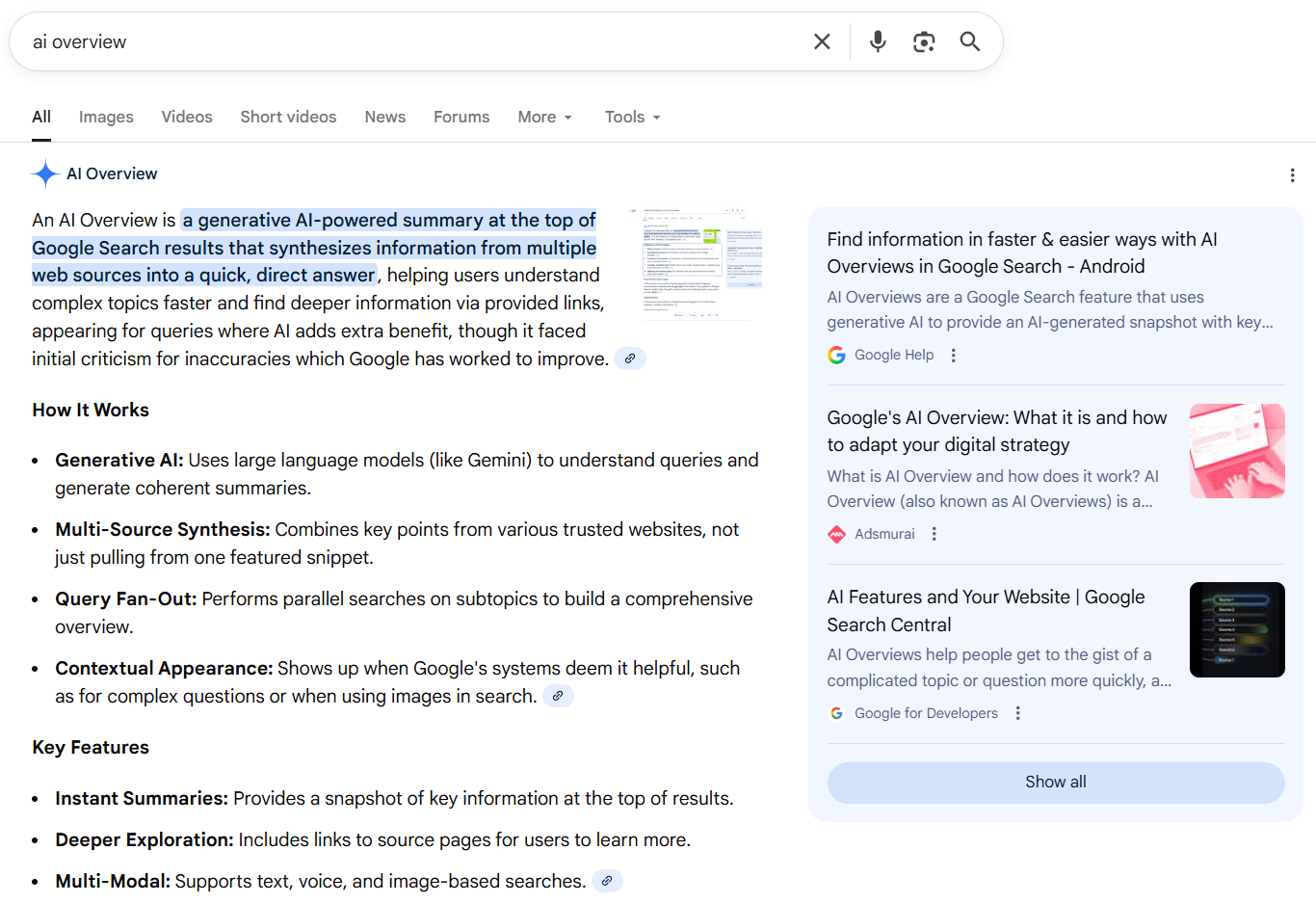
In practice, AI Overview usually includes:
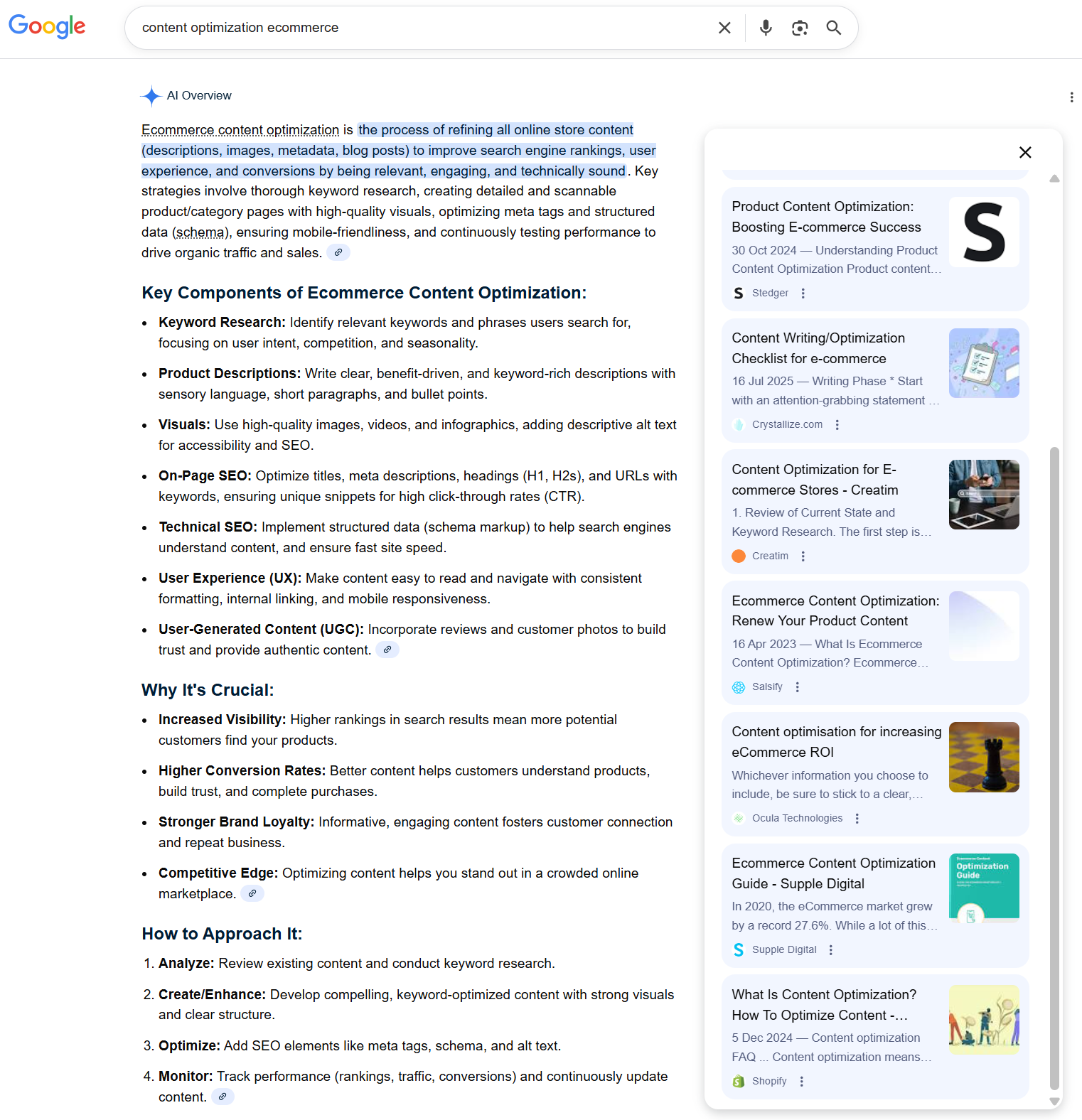
The goal is for our website to be among these links or sources. This allows our page to appear at the very top of Google Search, and we also have a good chance that the user will click on it if they want more information.
Google says that AI Overviews appear when its systems determine that a generative answer is particularly helpful (for example, to understand a topic more quickly by combining information from multiple sources). They are more likely to be triggered for informational and longer queries.
At the moment, we are seeing AI Overviews appear more frequently for English-language keywords, but it is expected that in the future they will also appear more often for search queries in Slovenian (and other languages).
No. SEO remains the foundation. AI Overview is usually powered by content that is already ranking well in traditional search results. If you want to be among the sources, you first need to meet the conditions for Google to see you, understand you and rank you at all.
To build AI Overview summaries, Google most often uses search results that occupy the highest positions on Google. A study by surferseo.com found that in 52% of cases, the page shown is among the top 10 results in the search engine. So if your website is well optimised and ranks well for a given query, there is a high probability that it will also appear in AI Overview. This means that classic SEO optimization is still the basis for good rankings.
GEO is therefore an upgrade, not a replacement. Once you have a solid SEO foundation, you can use GEO techniques to increase the likelihood that your URL will be selected as a source in AI Overview.
We’ll present some GEO optimization techniques in the following sections.
Advertising has also started appearing in AI summaries. Google can display ads above, below or even within AI Overview itself. The key point is that this is not a new ad type, but a new placement for Google Ads: existing Search/Shopping (and in some cases Local and App) ads from your campaigns can appear there, and they’re still ranked through the usual auction.
Ads are triggered mainly for queries where Google detects commercial intent and has enough high-quality, relevant ads available. For an ad to be shown inside AI Overview, it must also match the context of the AI summary content.
AI Mode is a newer feature of Google Search (introduced in 2025) that extends the classic “I type into Google → I get a quick summary and a list of links” logic into a more conversational, in-depth way of searching. Instead of just showing a quick summary, AI Mode provides a longer, structured answer that:
The key difference compared to AI Overviews lies in depth and purpose:
It supports follow-up questions, gradually narrowing down the problem and guiding the user through more complex topics. At the same time, it still stays connected to the web, as it shows links to sources alongside the answer so you can verify or read more in depth.
Update: In February 2026, Google added 53 new languages to AI Mode, including Slovenian, which means the mode now supports just under 100 languages. You can view the full list of languages here.
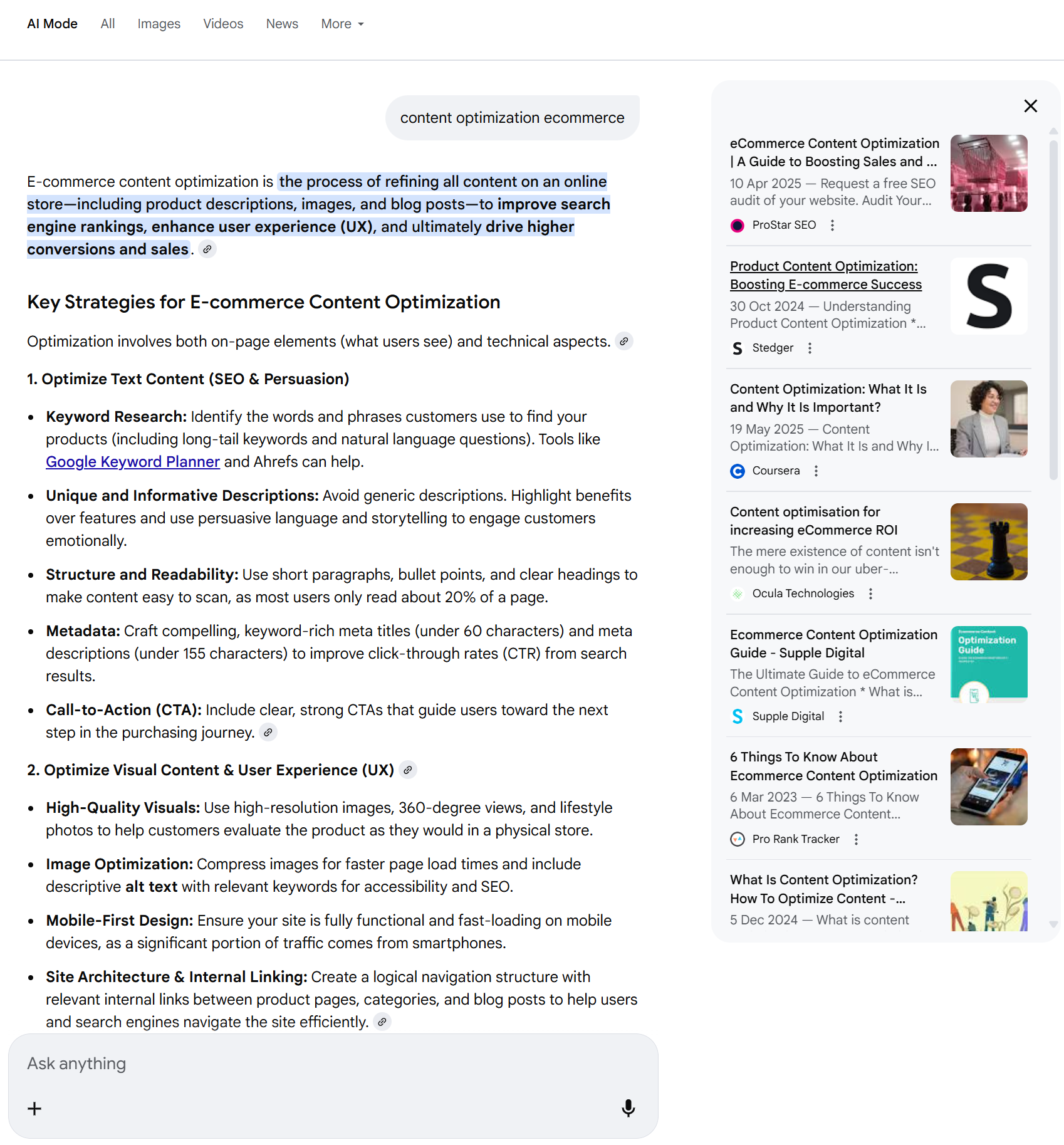
Update (January 22, 2026): Google has expanded AI Mode with the introduction of Personal Intelligence, marking an important shift toward more personalized search experiences.
Personal Intelligence allows AI Mode to take broader user context into account when generating responses—such as past searches, interests, and preferences—resulting in answers that are not only generally relevant, but tailored more closely to the individual.
As a result, AI Mode no longer responds merely to a query itself, but to the query within the user’s context, further emphasizing Google’s transition from a traditional search engine to a personal research assistant.
As we’ve already established, the main purpose of AI summaries is to provide a quick and clear display of the key information, i.e. the answer to the user’s question.
In practice, this brings:
Your website can only appear in AI Overview if it is indexed and meets the technical requirements for being shown in search results. Check your website’s robots.txt file and make sure access is allowed.
Mini-checklist:
As with classic SEO, a logical site structure is also important for AI Overview, achieved through well-organised internal links. A clear hierarchy helps language models understand:
Build topical clusters where one “main” page covers the topic in a comprehensive way, and supporting pages tackle individual questions.
Schema markup is code added to a website’s HTML to help search engines understand and categorise your content. This leads to enhanced search results (rich snippets) that contain additional information such as ratings, product prices, recipes and similar.
As a result, schema markup improves the ratio between impressions and clicks. It uses the shared vocabulary from schema.org (Google, Bing, Yahoo and Yandex) to define entities such as people, places and products, making the content easier to understand both for search engines and artificial intelligence.
Jezikovne modele privlači kakovostna vsebina, pri kateri je jasno, da jo je pisal izkušen strokovnjak - ne umetna inteligenca. Kredibilnost dokažemo tako, da navajamo svoje izkušnje in študije primerov in vključimo preverjene statistične podatke, pri katerih dodamo tudi povezavo oz. vir informacij.
Raziskava podjetja surferseo.com je pokazala, da se točna iskalna poizvedba v AI povzetku pojavi le v 5,4 %, kar pomeni, da je najbolj pomemben kontekst in pomen spletne strani, ne pa striktno vključevanje ključnih besed.
Poleg kakovosti vsebine je nujno tudi, da se tako uporabnik, kot tudi jezikovni model, v njej znajde. To dosežemo tako, da je vsebina dobro strukturirana in razdeljena po logičnih odstavkih. Naslovi naj si sledijo po vrsti, torej en H1 naslov, ki mu sledijo H2, H3 in tako naprej.
Uporabljamo tudi različne tipe vsebine, kot so na primer naštevanja, alineje, tabele primerjav (prednosti in slabosti) in grafi ali različne multimedijske vsebine, kot so slike in videi.
Language models are drawn to high-quality content where it’s clear that it was written by an experienced expert – not by AI. You demonstrate credibility by citing your own experience and case studies and including verified statistics and data, with links to sources.
A study by surferseo.com showed that the exact search query appears in the AI summary in only 5.4% of cases, which means that context and meaning are more important than strict keyword matching.
Besides content quality, it’s crucial that both the user and the language model can easily navigate the content. You achieve this by structuring the content well and dividing it into logical paragraphs. Headings should follow in order: one H1 heading, followed by H2, H3 and so on.
You should also use different content types, such as lists, bullet points, comparison tables (pros and cons), charts, and various multimedia elements like images and videos.
As already mentioned, language models like structured content that answers questions. You achieve this by adding a FAQ block with the most important questions and answers, supported by FAQPage schema markup. You can see an example at the end of this blog.
Your website will be shown more often if Google sees it as authoritative and trustworthy.
What helps here:
AI Overview and AI Mode are changing the classic way users “Google” – from a list of links to instant, generated answers and conversational topic exploration. Alongside organic results, advertising is also shifting: AI Overviews open up a new ad placement where Search and
Shopping ads are integrated into the context of the AI summary itself. So the goal is no longer just “being #1 on Google”, but also becoming a reliable source from which Google draws its summary.
The foundation for this is still solid SEO: technically sound pages, clear structure, internal links, schema markup and high-quality content. GEO is the logical upgrade – optimising content so that it’s also easy for language models to understand (answer-first approach, FAQs, topical clusters).
Brands that start thinking early in terms of a combination of SEO + GEO + building brand authority will have a much better chance of appearing in AI Overview – and staying ahead of the competition. If you need help with that, our experts are here for you.
Not in the same way as for classic ads or featured snippets. You influence your chances of appearing in AI Overviews indirectly – with a solid SEO foundation, high-quality and well-structured content, schema markup, a clear answer-first structure and strong brand authority. Google then decides which sources to include in the summary.
SEO makes sure you are visible in the search engine at all (technical SEO, on-page, off-page, authority). GEO is an upgrade, where you think about how your content is read by language models: clear answers, FAQs, topical clusters, and a structure suitable for summaries.
For simple, informational questions, some clicks do indeed get “captured” by AI Overview, because the user already gets their answer in the summary. But if you are listed as a source, the clicks you do get are often more valuable – the user wants more information, comparisons or a concrete next step.
In standard analytics (GA, GSC), AI Overview doesn’t have its own label. You can detect it indirectly through changes in CTR and in impressions/clicks for queries where, based on your own testing in the browser, your keywords frequently trigger an AI Overview.
No. Ads are still displayed – they can simply also appear alongside or within AI Overview. SEO/GEO and advertising remain complementary strategies: organic content builds trust and authority, while ads provide extra visibility and control over your messaging.
First, fix the basics (technical SEO, indexation, site structure), then select your key pieces of content and rework them into an answer-first format: clear headings, a short answer at the top, more detailed explanation below, a FAQ block, schema markup and regular content updates.