E-commerce
Digital Transformation of a Company: What It Is, Why It Matters and How to Get Started

Digital transformation is one of those terms we often use, but we do not always mean the same thing by it. For some, it means a new website. For others, the implementation of a CRM system. For others, process automation, the use of artificial intelligence or moving business operations to the cloud. And all of this can be part of digital transformation.
The digital transformation of a company begins when technology is used to measurably improve business performance: a better customer experience, faster processes, less manual work, better data for decision-making or even a new business model.
Technology is important, but it is not the goal. The goal is better business.
In this article, we will explain what digital transformation means in practice, how it differs from digitalization, why it matters for companies and how to approach it without unnecessary complexity.
Digital transformation is a comprehensive change in the way a company operates, where digital technologies are used to improve processes, customer experience, data-driven decision-making and often also the business model itself.
Put simply: digital transformation means that a company no longer thinks only about how to perform existing work with digital tools, but also about how technology can change the way the company creates value for customers.
Example:
If a company starts receiving orders through an online form instead of by email, this is a step toward digitalization.
But if the company sets up a B2B portal where the customer can see their contract prices, stock availability, delivery times, order history, invoices and recommendations for repeat purchases, the process changes significantly. The customer can handle more tasks independently, sales is relieved of routine work, data is connected to the ERP system and the company gains better control over the entire purchasing process. This is already digital transformation.
One of the most common mistakes is confusing digital transformation with digitalization.
| Term |
What it means |
Example |
|---|---|---|
|
Digitization |
Converting analog into digital | Scanning a document into a PDF |
|
Digitalization |
Digital support for an existing process | An online form instead of an email order |
|
Digital transformation |
A change in process, experience and business operations | A B2B portal connected to an ERP system |
An example from B2B sales:
If a salesperson manually copies an order from an email into the ERP system, the process is analog and inefficient.
If the customer submits the order through an online form, the process is digitalized.
But if the customer has access to a portal where they can see a personalized catalog, their own prices, stock availability, delivery times, past orders, repeat-purchase recommendations and the status of complaints, the entire experience changes. The salesperson is no longer in the role of an order-entry clerk, but of an advisor. The customer has more control. The company has better data.
That is digital transformation.
Customers have become used to simple digital experiences. In their private lives, they can order a product in a few clicks, track delivery, make a payment, change an appointment or get support.
These expectations are also transferring to the B2B environment.
A B2B customer may still value a personal relationship with a salesperson, but that does not mean they want to send an email or make a phone call for every piece of information. Often, they simply want to quickly check a price, stock availability, technical data, order status or documentation.
Digital transformation helps companies meet these expectations more efficiently.
The most common benefits of digital transformation are:
The greatest value often appears where the company combines three things: a strong understanding of the customer, well-organized processes and the right technology.
Digital transformation is not only suitable for large companies. It is often most needed by companies whose business volume has grown, while their processes have not kept pace with change.
Typical signs that a company needs digital transformation:
In such cases, the problem is not only technological. It is a business problem. Technology can help, but only if we first understand where friction occurs: with the customer, employees, data, processes or systems.
Many companies start in the wrong place. First, they choose a tool, platform or technology, and only then ask what they will improve with it. The better approach is the opposite.
The digital transformation of business must begin with the customer and their key tasks.
Ask yourself:
In a B2B environment, the answers are often very concrete. The customer wants to quickly find the right product. They want to see their price. They want to know whether the product is in stock. They want to order again without searching through old emails. They want to download an invoice, delivery note or technical documentation. They want to submit a complaint and track its status.
If the company solves these needs digitally, it not only improves the user experience. It also relieves the internal team.
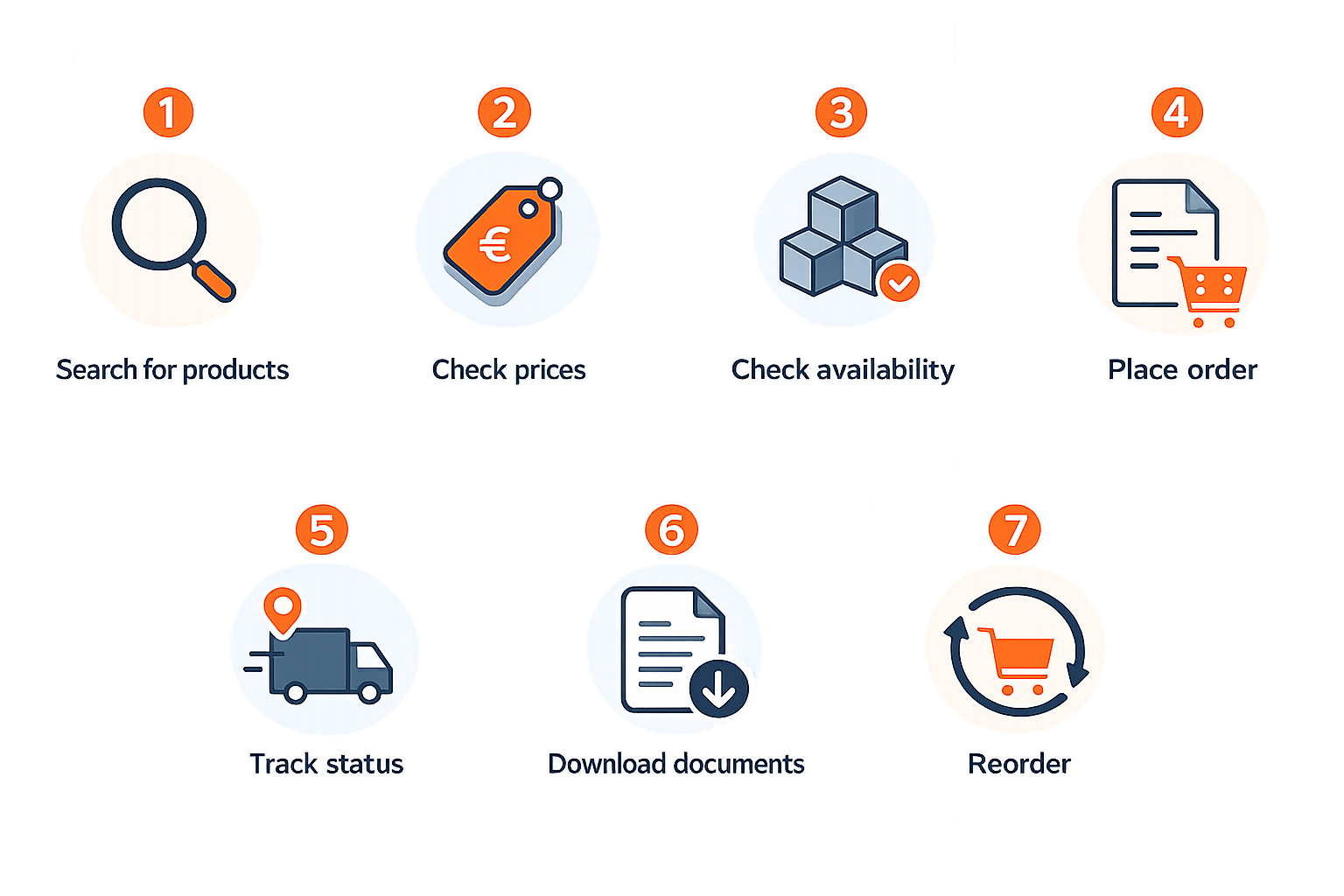
Digital transformation is easiest to understand through concrete examples. In practice, it does not only mean introducing new technology, but changing the way a company sells, communicates with customers, manages data or organizes work.
At Creatim, we have worked on several projects where a digital solution removed concrete business friction and created value for customers, employees or the company.
At BTC, the goal was to improve communication with tenants and reduce the amount of manual work. By introducing a B2B portal, business partners gained a single place to review costs, notifications, payments and business history.
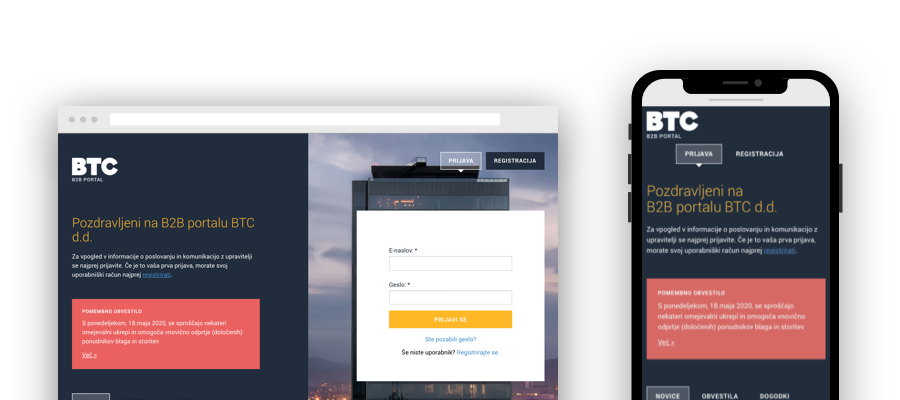
The example clearly shows that digital transformation is not only the digitalization of communication, but a change in the way a company collaborates with its partners. Users gain more independence, while employees have fewer routine tasks.
Fortrade needed a B2B online store that would support real sales and logistics processes. The solution included integration with the ERP system, data migration and functionalities such as packaging quantities, partial deliveries, delivery-date calculation and different user roles.

This is a good example of digital transformation in a B2B environment, where the online store is not just a sales channel, but part of a broader business system.
At Rexel, formerly Elektronabava, the challenge was to digitalize complex B2B sales processes with thousands of customers, different terms, contracts and discount scales.
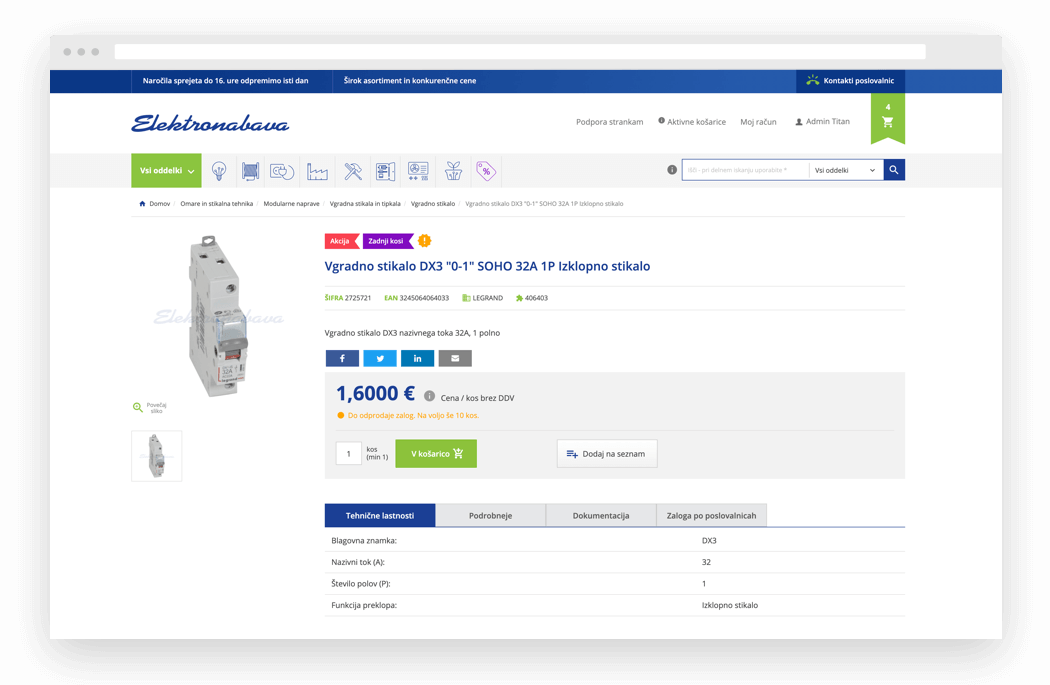
The project shows that digital transformation is not just the technical implementation of a platform. It is successful when the company first understands business rules, data and exceptions, and then converts them into effective digital processes.
DZS needed a solution for different types of customers: end consumers, parents, schools, companies and other business users. The new platform supports both B2C and B2B scenarios, while B2B customers are provided with customized catalogs, permissions, limits and order-approval processes.

The example shows that digital transformation must be based on user experience. Different users need different journeys, functionalities and levels of independence.
Alma, the virtual travel companion for the Slovenian Tourist Board, is an example of using artificial intelligence to improve access to information. The goal was not to add AI for the sake of technology itself, but to enable visitors to the portal to find answers faster and more naturally.

This example shows that artificial intelligence has the greatest value when it solves a concrete user problem.
All of these examples have one common denominator: the digital solution was not the goal in itself. The goal was to improve business — to reduce manual work, connect systems, improve the user experience or enable a new way of communication.
That is why digital transformation is not a question of which technology to use, but which business problem we want to solve and how technology can create measurable value.
The best start is not a large project, but a clear diagnosis. Digital transformation must have a business reason. Without it, it quickly becomes a list of tools that no one really uses.
We recommend the following approach:
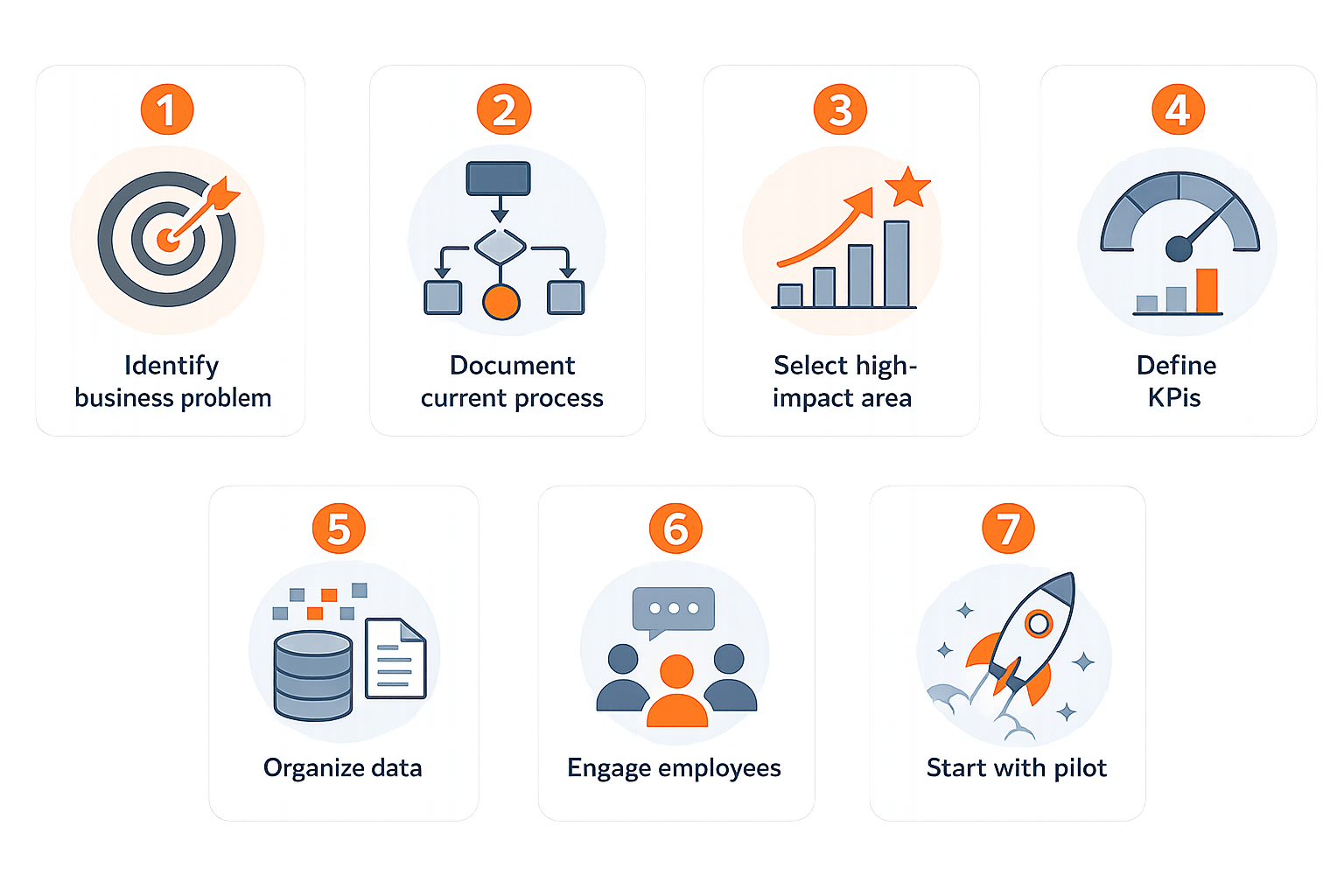
Do not start with the question: “Which platform do we need?” Instead, ask: “Which problem do we want to solve?”
Examples of good starting points:
The more concrete the problem, the easier it will be to choose the right solution.
Before you improve a process, you need to understand it.
Document how the process works today:
Companies quickly discover that the issue is not only technology, but unclear rules, disconnected systems or processes that have grown historically over time.
Digital transformation does not need to start everywhere at once. It is better to choose one area where the effect will be visible quickly.
For example:
It is important to choose an area where business value and feasibility meet.
If you do not know what you want to improve, you will not know whether the project is successful.
Possible KPIs:
KPIs should be connected to the business goal, not only to technical delivery.
It is not enough for the new platform to be launched. What matters is whether customers and employees use it and whether it creates a measurable effect.
Digital transformation quickly comes to a standstill without well-organized data. If product data is incomplete, prices are inconsistent, stock information is inaccurate or customers are duplicated across multiple systems, the new digital solution will only expose old problems.
That is why the following must be organized in time:
In B2B e-commerce projects, data quality is often one of the key success factors.
Digital transformation is not successful if employees experience it as something that has happened to them. They need to be involved early.
Sales, support, logistics, marketing, IT and management each have their own view of the process. If you involve them only at the end, you will probably overlook important details.
Employees need to understand:
Digital transformation does not mean that people become less important. It means that their time is redirected from routine work to work with higher added value.
Instead of a large implementation for all customers and all processes, it is often better to start with a pilot.
Choose a limited segment:
A pilot allows you to test and improve the solution before expanding it. This reduces risk and helps you find out faster what works in practice.
Digital transformation is not challenging only because of technology. It is challenging because it
changes the way people work. The most common mistakes are the following.
The company chooses a platform because it is modern, not because it solves a clear business problem.
Result: many functionalities, little use.
If the process is confusing, the digital solution will only accelerate the confusion.
Before digitalization, the process needs to be simplified.
Poor data means a poor user experience. A customer cannot trust the portal if prices, stock information or product descriptions are incorrect.
If the online solution is not connected to ERP, CRM, PIM or other key systems, manual work is often only moved elsewhere.
Digital transformation needs an owner on the business side. IT can help, but it cannot define business priorities on its own.
If users do not understand or trust the solution, adoption will be slow.
A project is not successful simply because it was launched. It is successful if it delivers measurable business results.
B2B digital transformation has several specific characteristics.
Purchasing processes are often more complex than in B2C. Customers have contract prices, special terms, different user roles, internal approvals, repeat orders and technical requirements.
That is why a B2B digital solution cannot be just an “online store”. It often needs to support:
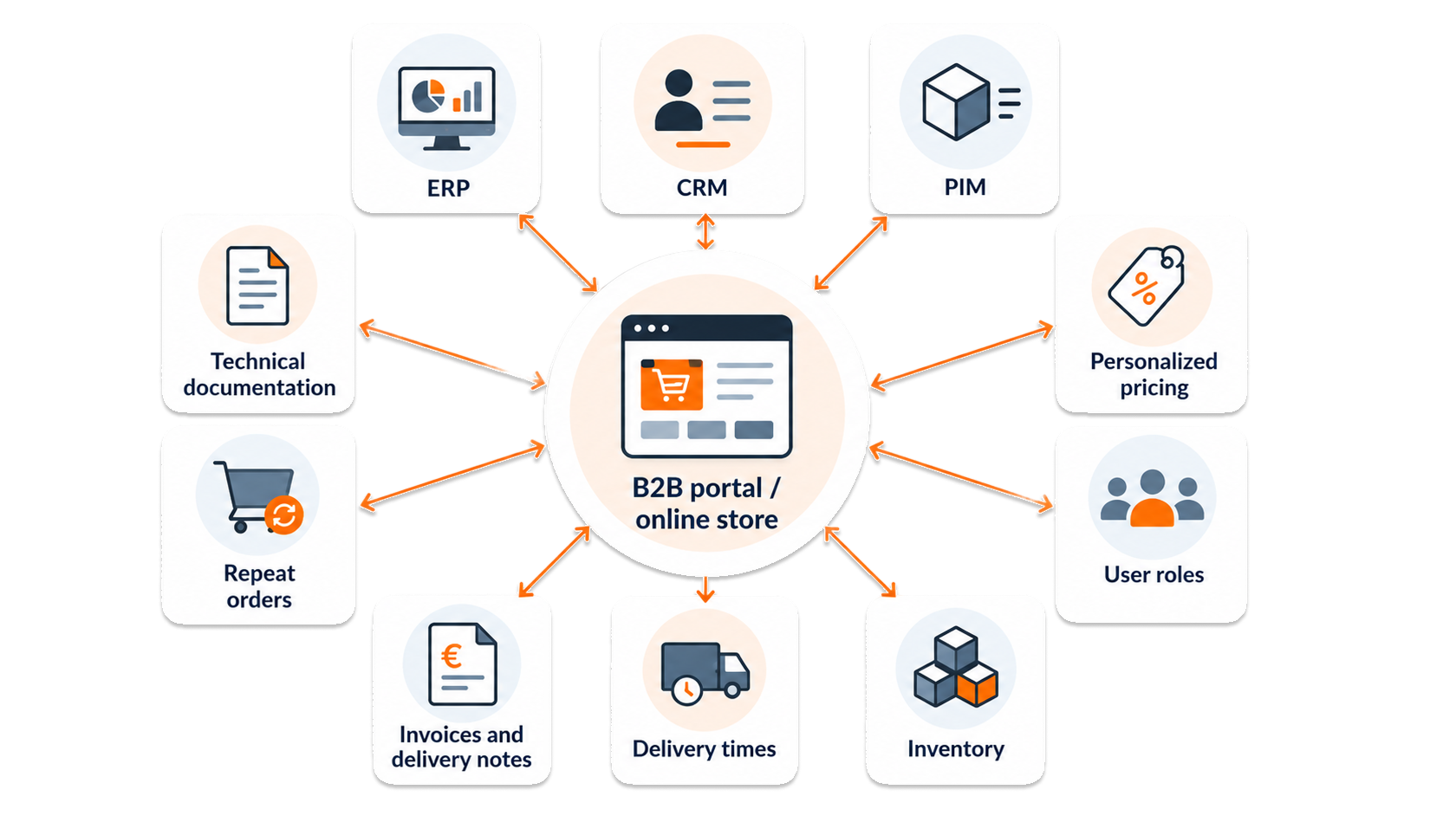
In a B2B environment, digital transformation is not intended to make the personal relationship disappear. It is intended to use that personal relationship where it has the greatest value.
A salesperson should not waste time sending documents, checking statuses and re-entering orders. Their value lies in advising, understanding the customer, developing the relationship and identifying new opportunities.
Artificial intelligence can accelerate digital transformation, but it is not a shortcut past disorganized processes and data.
AI is most useful when the company already has the basic building blocks in place: quality data, connected systems, clear processes and a sufficiently good understanding of user needs.
Possible uses of AI in digital transformation:
AI can greatly increase efficiency, but only if it solves the right problem.
Digital transformation must have a measurable effect. Measurement is important for two reasons. First, so we know whether the project creates value. Second, so we can improve the next steps based on data.
Indicators can be divided into four groups.
These show whether we are working faster and with fewer errors.
Examples:
These show whether the experience is better for customers.
Examples:
These show the impact on revenue and sales opportunities.
Examples:
These show whether the company is actually changing the way it works.
Examples:
The best KPIs are those that connect user experience, internal efficiency and business results.
One of the biggest misconceptions is that digital transformation is a project with a clear beginning and end.
In reality, it is more a way of developing the company.
Of course, an individual project can have a beginning and an end: the implementation of a portal, system renewal, ERP integration, PIM implementation or process automation.
But digital transformation as a business direction does not end with launch. After launch, it is necessary to monitor usage, measure effects, collect feedback, improve processes and add new functionalities.
The most successful companies do not see digital transformation as one large one-time leap, but as a sequence of thoughtful improvements.
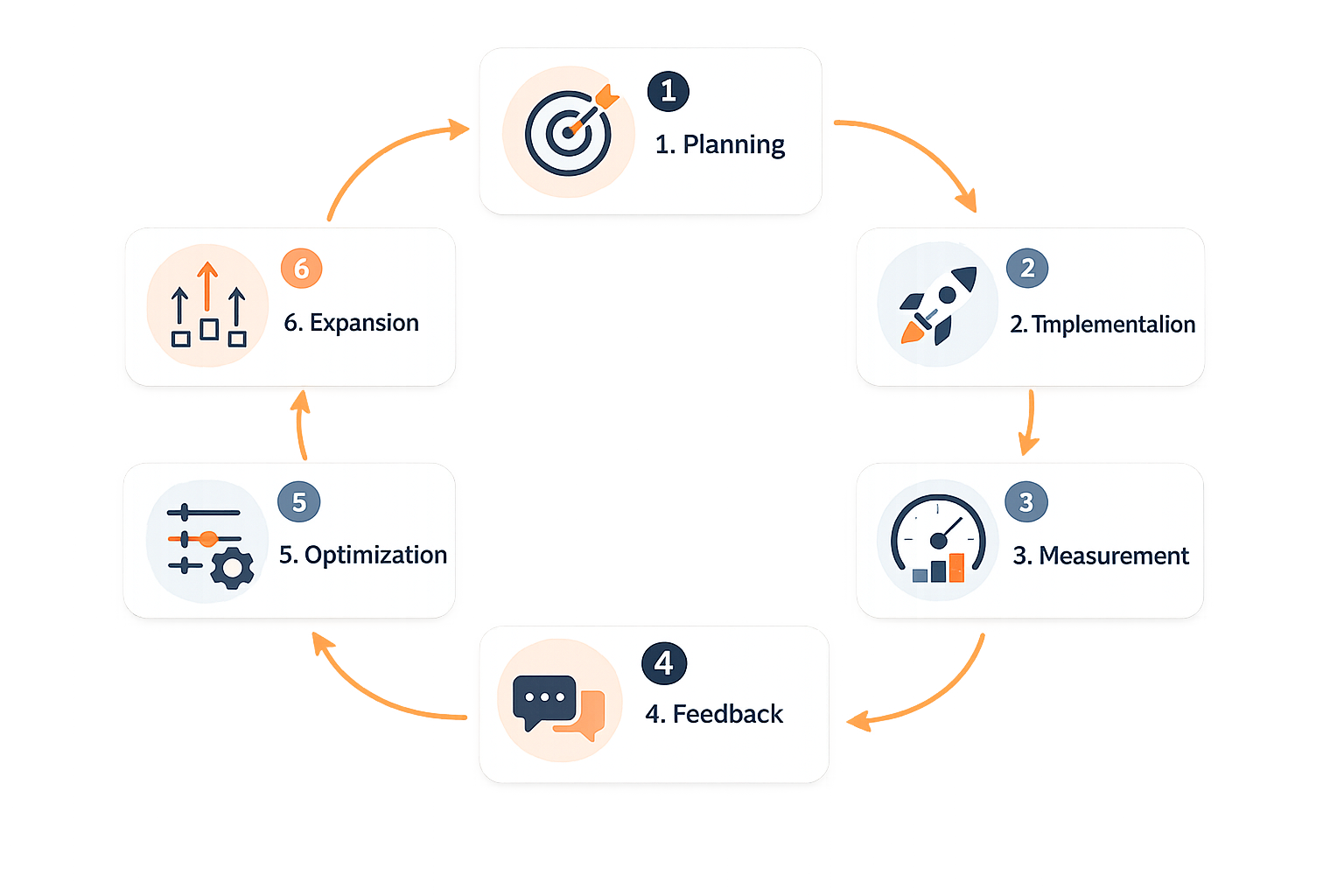
Not every company is ready for the same level of ambitious digital transformation.
Some companies first need organized data. Others need better system integration. A third group needs a new B2B portal. A fourth must first simplify its processes.
The right step depends on three things:
Sometimes the best start is small: for example, self-service access to documents for existing customers.
Sometimes a larger step is needed: a redesign of the entire digital sales experience. The important thing is not to start with the loudest idea, but with the most sensible one.
In the digital transformation of companies, we often encounter questions such as:
At Creatim, we help companies design and develop digital solutions that are not only technologically sound, but also have a clear business purpose.
Digital transformation is successful when it combines strategy, user experience, technology, integrations and an understanding of business processes.
If you are considering the digital transformation of your company, it makes sense to start with an assessment of the current situation: where the biggest obstacles are, which opportunities have
the greatest impact and which first step makes the most sense.
Would you like to check where your company has the greatest potential for digital transformation?
Digital transformation is a comprehensive change in business operations through the use of digital technologies. Its goal is not only to introduce new tools, but to improve processes, user experience, data-driven decision-making and business results.
Digitalization means supporting existing processes with digital tools. Digital transformation means rethinking processes, user experience, data and the way a company creates value for customers.
It is important because customers expect faster, more transparent and simpler experiences. It helps companies reduce manual work, connect systems, make better use of data, improve efficiency and respond more quickly to market changes.
The best starting point is a clear definition of the business problem. The company should first identify where the greatest friction occurs for customers or employees, then map the existing process, define goals, select a pilot area and set measurable KPIs.
No. IT is an important part of implementation, but digital transformation is a business change. It involves management, sales, marketing, support, operations, finance and other departments. Technology enables the change, but it cannot define business goals by itself.
Examples of digital transformation include a B2B customer portal, connecting an online store with an ERP system, automation of repeat orders, a self-service support center, digitalization of the quotation process, using data for personalization and introducing an AI assistant for user support.
It depends on the scope, company maturity, data quality, system complexity and goals. An individual project can take a few months, while broader digital transformation is a long-term process that develops in phases.
Success is measured with business KPIs, such as shorter order processing time, fewer manual entries, fewer errors, greater use of digital channels, better customer satisfaction, more repeat purchases and lower process handling costs.
Not every company needs the same level of digital transformation, but almost every company needs to consider how technology can improve processes, customer experience and business efficiency. The key is to choose the right step based on customer needs and business goals.