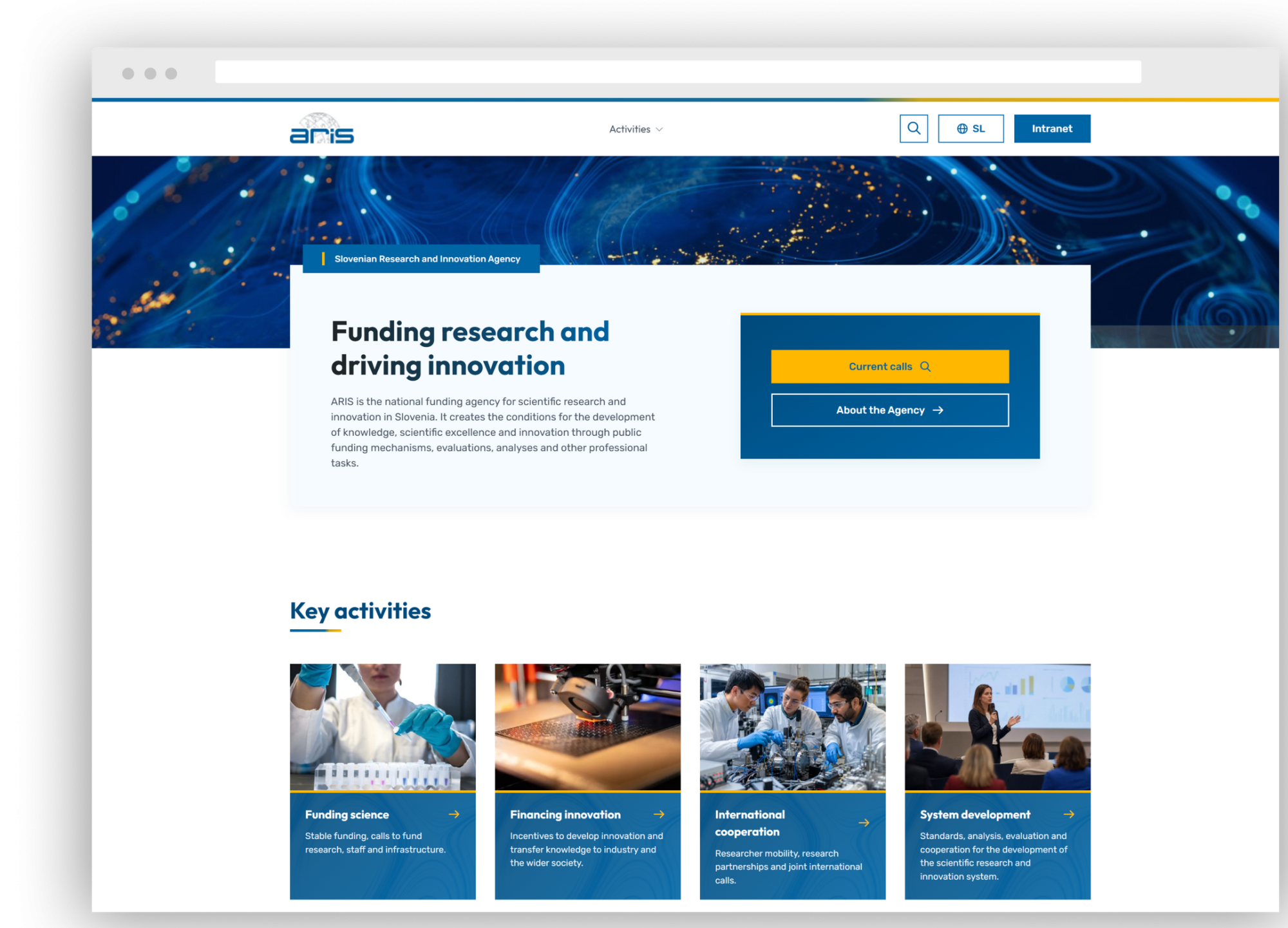
The Slovenian Research and Innovation Agency plays an important role in Slovenia’s research and innovation ecosystem. Its website must therefore serve a wide range of users, including research organisations, applicants for calls for proposals, researchers, companies, partners, the media and the general public.
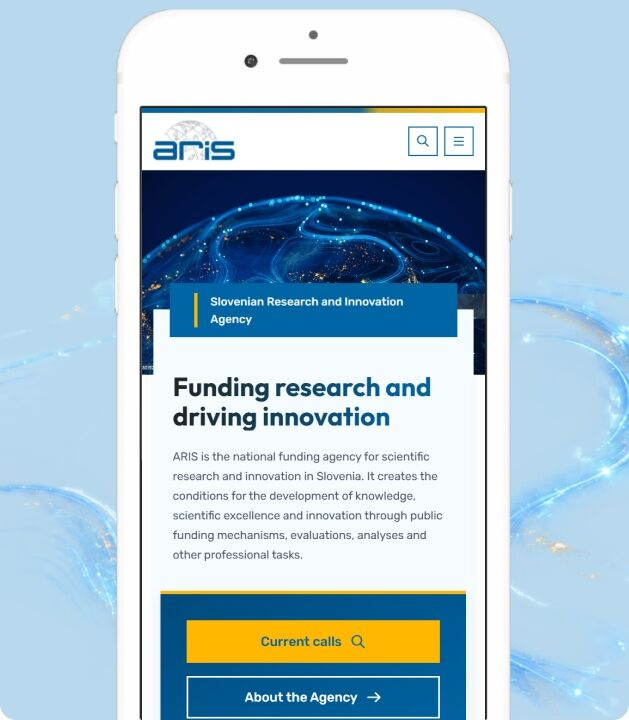
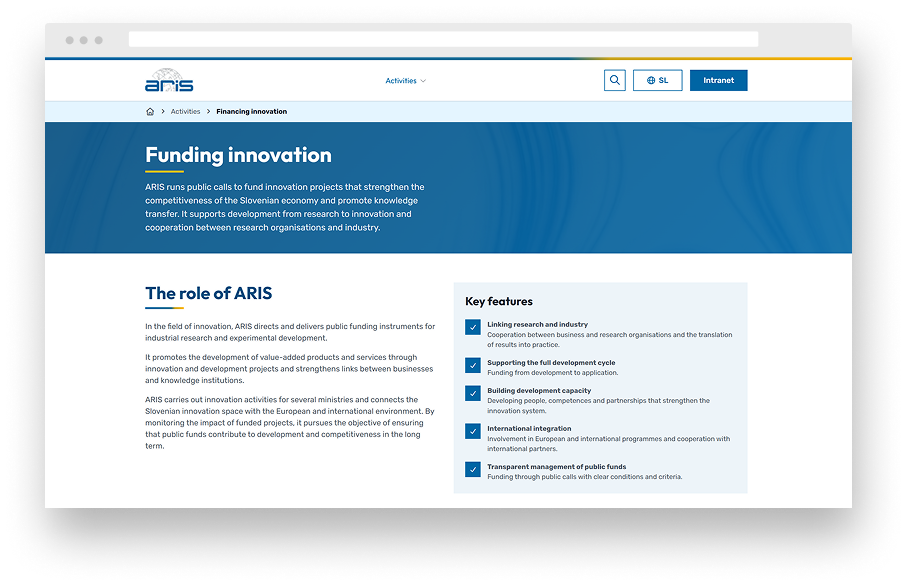
As part of the ARIS website redesign, we created a modern, transparent and modular portal that gives users faster access to calls for proposals, results, notices, funding information, data resources and content related to the development of the research and innovation system.
The project was not merely a visual redesign. It involved building a comprehensive digital platform that combines a public information portal, an advanced content structure, a content management system, search functionality, integrations and public-sector accessibility requirements.
The Challenge: Making Complex Information Easy to Understand
ARIS manages a large volume of frequently changing, high-value information. Calls for proposals, call results, notices, news, events, publications, legal frameworks, documents and data resources must be readily accessible to users while also being structured precisely enough to support long-term maintenance.
The key challenge was translating the portal’s complexity into a clear user experience. Users need to find current calls quickly, understand the available funding areas, access forms and follow information relevant to their work. Editors, meanwhile, need a system that allows them to publish, edit and connect content easily, without unnecessary dependence on technical support.
The redesign had to bring together several objectives: a clearer public-facing portal, a more effective presentation of the agency’s activities, better support for applicants, integration with the RRI Hub and easier access to digital forms and data resources.
The Solution: A Portal Built Around User Journeys
The new website is structured around users’ main tasks: monitoring calls for proposals, understanding funding areas, accessing services, finding information and gaining insight into the agency’s work.
Particular emphasis was placed on calls for proposals, as they represent one of the portal’s most important user journeys. From the calls overview, users can quickly navigate to open, closed or planned calls, as well as published results. Each call is structured to bring together key information, deadlines, conditions, documents and links to application forms in one place.
Calls for Proposals as a Core User Journey
The calls section of the portal was not designed as a conventional list of announcements, but as a system that helps users understand what is currently open, what is approaching its deadline, where results have been published and which documents are relevant to an application.
Content is organised by type, status and category, enabling clearer navigation through a large volume of information. Each call detail page is structured to support quick orientation: users first receive the essential information and can then explore the conditions, evaluation criteria, contact details, timeline and documentation in greater depth.
In this way, calls for proposals become a complete user journey rather than merely an archive of announcements. The portal guides users from an overview of available opportunities to the specific information required to submit an application.
A Clear Structure for Different Audiences
ARIS operates across several areas: funding science, funding innovation, international cooperation and developing the research and innovation system. The new information architecture presents these areas as distinct content sections, guiding users from a general understanding of each area to specific information, calls for proposals and supporting content.
As a result, the portal is not intended only for people who are already familiar with the agency’s work. It also serves users encountering ARIS for the first time and provides them with a clear entry point into the complex field of public funding for research and innovation.
A Modular CMS for Long-Term Editorial Work
Editors need to be able to publish, update and interconnect content quickly. The website was therefore built around a modular structure supporting different content types, components and dynamic displays.
The content management system supports news, notices, events, calls for proposals, call results, publications, documents, frequently asked questions and other content sections. This approach allows the portal to remain clear and easy to navigate for users while providing the editorial team with the flexibility it needs.
The content models are designed to support everyday editorial work, archiving, links to documents, email notifications and integrations with other systems.
Search Designed for a Complex Portal
On a portal containing a large volume of content, search is one of the most important features. Users do not always search in the same way: some know the name of a specific call, while others search by funding area or look for a document, form, publication or result.
The search engine was therefore designed as a combination of quick access, filtering and results grouped by content type. Users can enter a search term or narrow the results using filters such as content type and time period.
Results are ranked by relevance and displayed in clearly defined sections, making it easier to navigate a large collection of content.
Data and Transparency
Access to data, analyses and indicators is another important part of the ARIS digital experience. The data portal gives users insight into key data relating to the research and innovation system, as well as relevant releases, publications and resources.
This section expands the website’s core informational role. It provides users not only with news and documents, but also with a more structured view of how the system operates, the results of public funding and the broader context in which science and innovation are developing.
Integration with the ARIS Digital Ecosystem
The redesigned portal is conceived as part of a broader digital ecosystem. It connects the public website, the RRI Hub, digital forms, data sources, and editorial processes.
For users, this means a less fragmented experience: information, calls for proposals, forms, documents, and data are linked together in a more meaningful way. For the agency, it means a more sustainable digital platform that can evolve alongside the development of its services and content.
Accessibility as an Essential Part of a High-Quality Public Portal
As this is the website of a public institution, accessibility is not an optional feature but one of the project’s fundamental requirements. The portal must be designed so that it can be used by a wide range of users, regardless of their device, navigation method, or any disabilities they may have.
Key considerations in its design and implementation therefore include a clear page structure, semantically correct content, appropriate colour contrast, support for keyboard navigation, descriptions of visual elements, and the predictable behaviour of interactive components.
The Result: A Clearer, More Connected, and More Sustainable Portal
The redesigned ARIS website provides users with a clearer path to the information they need—from current calls for proposals and results to funding areas, documents, publications, and data sources.
For editors, the new platform enables a more structured and sustainable approach to content management. For the agency, the portal serves as a modern digital gateway that brings together information, public funding, data, and the wider research and innovation ecosystem.
Do You Need a Digital Solution for a Complex Content System?
We help public institutions and organisations design web platforms that are clear and intuitive for users, efficient for editors, and ready for long-term growth.
Book a Free Consultation